How to Build a Personal Brand on Social Media, Step by Step
Seven steps to a personal brand on social media: positioning, content pillars, a written voice, the right networks, one home page, scheduling ahead and monthly reviews.
On this page
- Key takeaways
- Step 1: Decide what you want to be known for
- Step 2: Choose three or four content pillars
- Step 3: Define your voice
- Step 4: Pick your main networks
- Step 5: Build a home page that ties every channel together
- Step 6: Stay consistent by scheduling ahead
- Step 7: Review what is working every month
- Personal brand examples to learn from
- Frequently asked questions
A personal brand on social media is what people come to expect from you: the topics you cover, the way you talk about them and the reason to follow you rather than someone else. You build it deliberately in seven steps: decide what you want to be known for, choose a few content pillars, define your voice, pick your main networks, connect them through one home page, schedule ahead so you stay consistent and review what is working. This guide walks through each step with examples you can adapt.
Step 1: Decide what you want to be known for
Positioning is the part most people skip, and it is the reason many accounts feel scattered. Before you post anything new, write one sentence:
I help [specific audience] [get a specific result] through [your angle or format].
Examples:
- “I help first-time founders understand their numbers through short, plain-English breakdowns.”
- “I help home cooks make restaurant-style dinners on a weeknight budget.”
- “I help junior designers build a portfolio that gets interviews, by reviewing real ones.”
Test your sentence with three questions:
- Is the audience specific enough that a stranger could tell whether it is them?
- Do you have credible experience or a genuine interest you can keep showing for years?
- Is there room for you? If many people already cover the topic, what does your angle add?
Your positioning can change later. Having one now gives you a filter for what to post and what to skip.
Step 2: Choose three or four content pillars
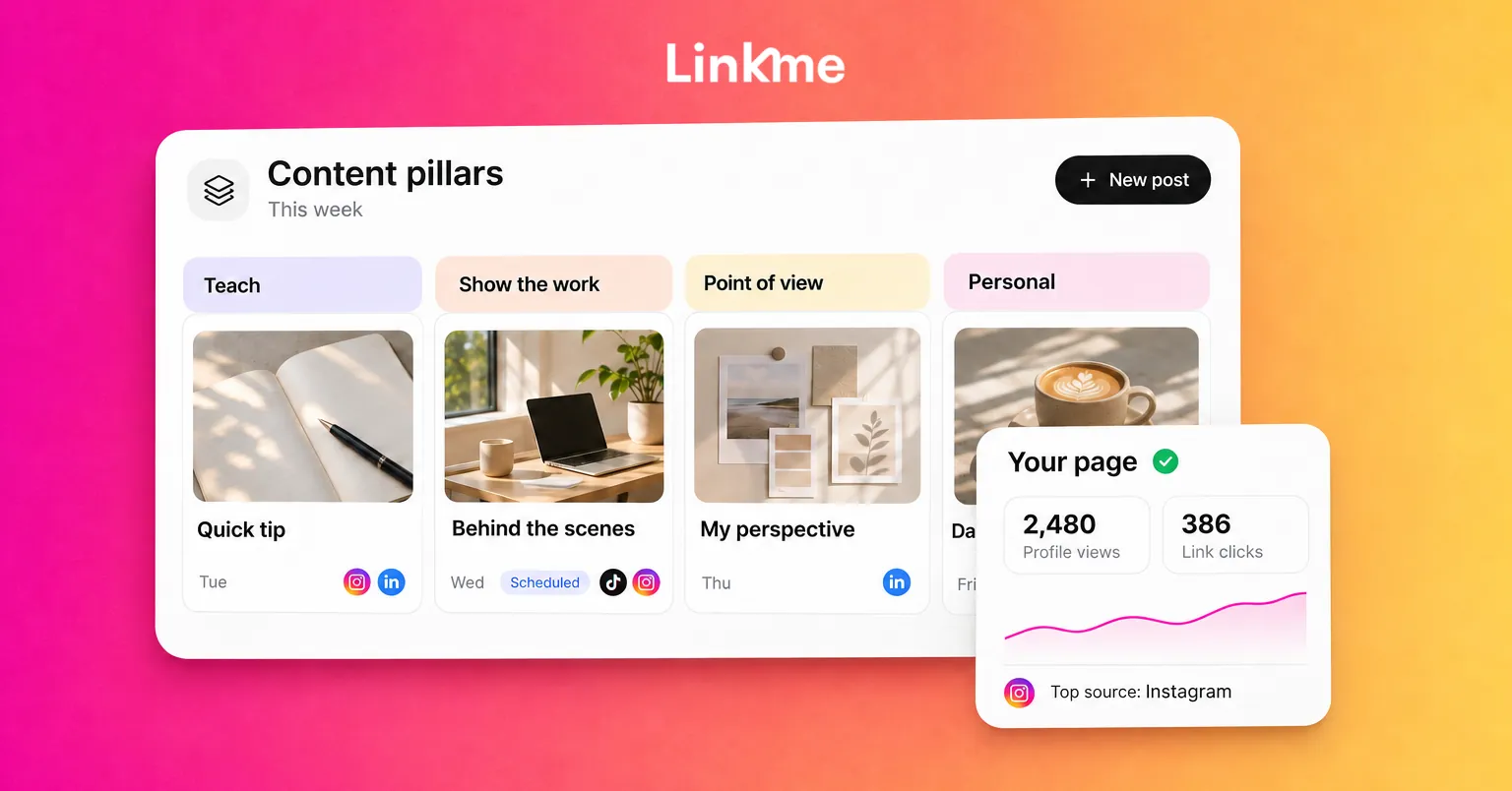
Content pillars are the recurring themes you post about. They make you recognizable, because followers learn what kind of post to expect, and they make planning easier, because you are filling known slots rather than starting from a blank page.
| Pillar | What it does | Example formats |
|---|---|---|
| Teach | Shows your expertise and gives people a reason to save posts | How-tos, checklists, carousels, short explainers |
| Show the work | Builds trust by showing the process behind results | Behind the scenes, before and after, work in progress |
| Point of view | Gives people something to agree or argue with | Opinions on news in your field, myths you disagree with |
| Personal | Makes you a person, not a feed | Lessons learned, routines, what you are working on |
For the founder example, that might be: money basics (teach), building in public (show the work), takes on startup news (point of view) and founder life (personal). Keep a running list of ideas under each pillar so you never run short.
Step 3: Define your voice
Your voice is how you sound across captions, videos and replies. Write it down so it stays consistent:
- Three words that describe it. For example: direct, warm, practical.
- Do’s. Use short sentences, give real numbers from your own work, admit what you got wrong.
- Don’ts. No jargon without explaining it, no clickbait you cannot back up, no copying other creators’ catchphrases.
Here is the same idea in two voices:
- Formal: “Founders should review cash flow on a monthly basis.”
- Direct and warm: “Check your cash every month. I didn’t, and it cost me a quarter.”
Neither is wrong. The point is to pick one and stay with it. If you use AI tools to draft captions, give them your voice guide and edit the result until it sounds like you.
Step 4: Pick your main networks
You do not need to be everywhere at once. Choose:
- One primary network, where your audience already spends time and your best format fits. Visual and short-video topics often suit Instagram or TikTok. Professional topics usually suit LinkedIn. Longer teaching suits YouTube.
- One or two secondary networks, where you repurpose the same ideas in a lighter way.
Use the same name, photo and short bio everywhere you can, so people recognize you when they find you somewhere new. Grab your handle on networks you might use later, even if you are not posting there yet.
Step 5: Build a home page that ties every channel together
Every network gives you limited room for links, and each one sends people somewhere different. A home page solves that: one address that holds your channels, your best work and a way to stay in touch.
A Linkme page for a personal brand might be laid out like this:
- An email sign up under your name, so followers can join a list you own
- Your main offer or current project, as a large featured link
- Links to every network, in a row at the top
- Your latest videos, pulled in from YouTube, TikTok or Instagram
- Your best pieces of work: an article, a case study, a talk, a portfolio
Put that one link in every bio. Page analytics show profile views, link clicks and the countries and cities people tap from, so you can see which channel sends the most interested visitors. The page also has a QR code for anything printed or presented on a screen.
Step 6: Stay consistent by scheduling ahead
Most personal brands stall because posting depends on finding time each day. Plan a week at a time instead:
- Pick a cadence you can keep, such as three posts a week on your primary network and two on a secondary one.
- Assign each slot a pillar, so the week is balanced without extra thought.
- Batch the work. Write captions in one sitting and record videos in another.
- Schedule everything before the week starts.
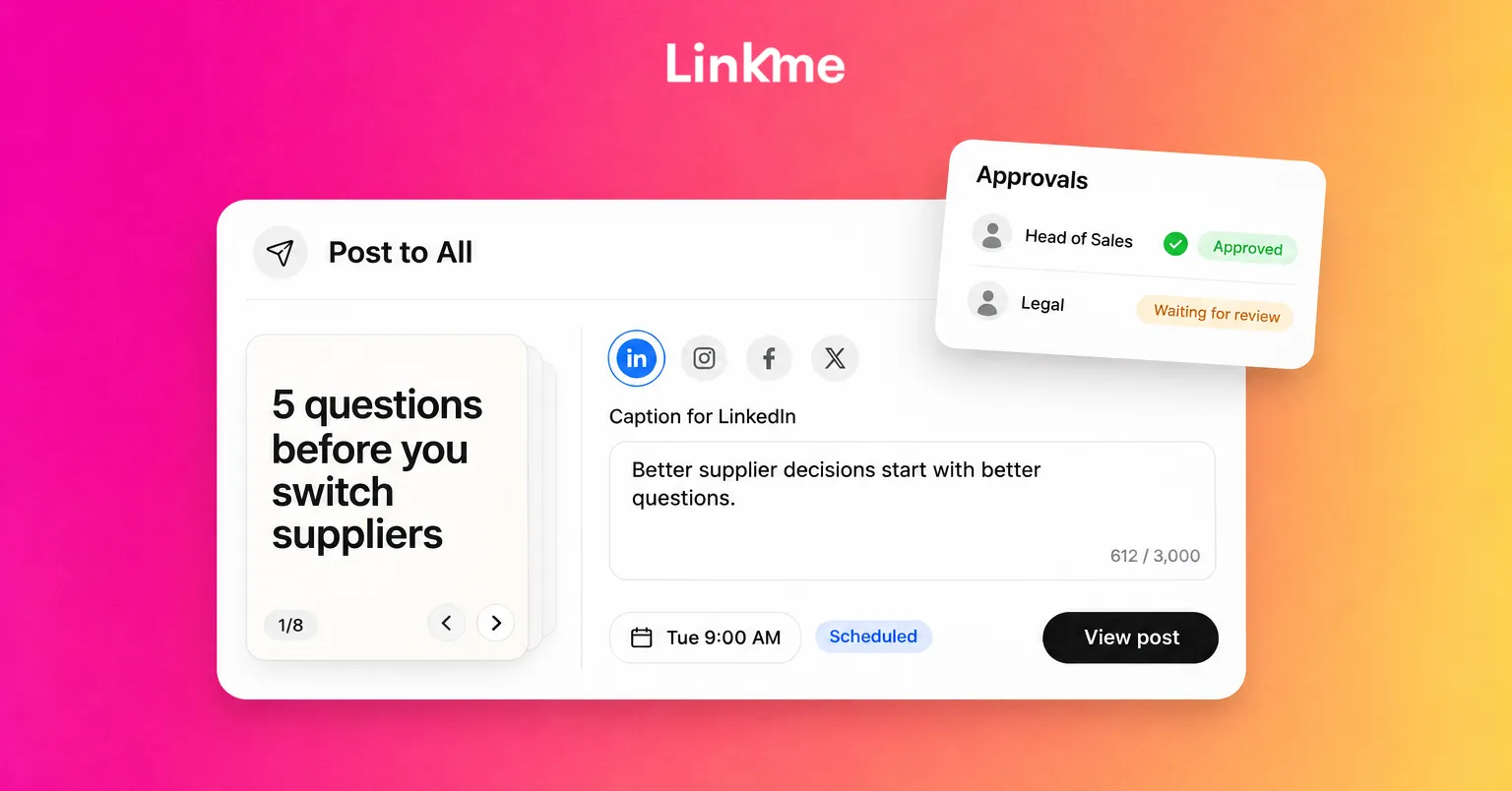
With Post to All, you upload a post once, write one caption or a separate one for each network (with each network’s character limit checked as you type) and schedule it to YouTube, Instagram, TikTok, Facebook, X, Threads and LinkedIn. A calendar shows everything that is going out. On Linkme Pro, Link, the AI Social Media Manager, can draft posts for you, and nothing goes live until you approve it. For a planning template, see how to create a social media calendar.
Step 7: Review what is working every month
Once a month, look back at your posts and ask:
- Which pillar earned the most saves, shares and comments? Do more of that.
- Which posts brought people to your page? Those topics attract followers who want more from you.
- What did people ask you? Questions in comments and DMs are your best source of new ideas.
- What felt forced? If a pillar is a chore, replace it.
Adjust one thing at a time, so you can tell what made the difference.
Personal brand examples to learn from
You can borrow the structure of these common personal brand types, whatever your field:
- The explainer makes a complicated topic simple. Pillars lean on teaching, and the home page leads with a free guide or newsletter.
- The builder in public shares a project as it happens. Pillars lean on showing the work, and the home page leads with the project itself.
- The curator finds the best of a topic and adds a point of view. The home page leads with a regular roundup.
- The local expert is the go-to person for a city or community. The home page leads with how to work with them.
Pick the one closest to you, then make it your own with your voice and your experience.
Frequently asked questions
How long does it take to build a personal brand on social media?
Most people need several months of consistent posting before they see steady growth. The first sign that it is working is usually not followers but repeat commenters, saves and people mentioning a post you made.
Do I need to show my face to build a personal brand?
No, but it helps people connect with you. If you prefer not to appear on camera, use your voice, your handwriting, your workspace or a consistent visual style so people still recognize your posts.
How many social media platforms should I use for a personal brand?
Start with one primary network and one or two secondary ones. Add another only when your routine on the first ones is stable and you have a clear reason, such as an audience that is clearly there.
How personal should my content be?
Personal enough that people know who is behind the posts, and no more than you are comfortable with. Share lessons, routines and opinions related to your positioning, and keep private matters private.
Your personal brand is the sum of many small, consistent choices. Linkme brings your page, your posts and your numbers into one place; see all Linkme features to decide what you need as you grow.