How Social Media Algorithms Work: Signals, Feeds and Myths
An explainer on what feeds rank and why: the signals Instagram, TikTok and YouTube describe, how recommendation feeds differ from follower feeds, and the myths to drop.
On this page
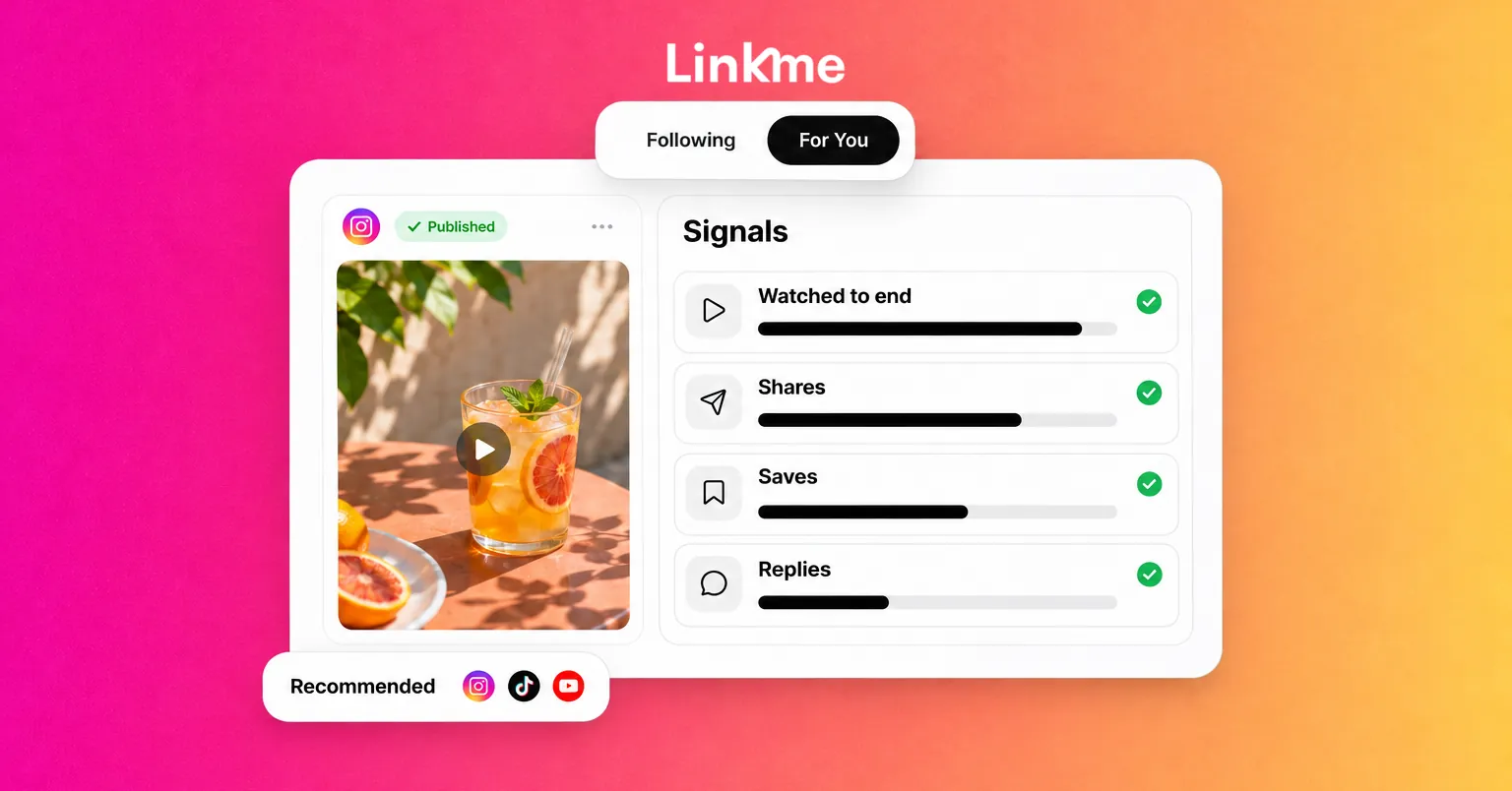
To understand how social media algorithms work, start with one idea: each feed tries to predict what a particular person will value next, then ranks the available posts by that prediction. The predictions come from signals such as what someone watches to the end, shares, saves, replies to or skips, plus information about the post and the account behind it. There is no single secret formula, and no network uses one algorithm for everything.
This explainer covers the signals the major networks say they use, how recommendation feeds differ from follower feeds and which common myths to stop worrying about.
What an algorithm actually does
A feed has far more eligible posts than anyone can see. Ranking decides the order. Most networks follow roughly the same process:
- Gather candidates. Posts from accounts you follow, plus posts the system thinks you might like.
- Collect signals. Information about each post, its creator, your past behavior and how others have responded.
- Predict actions. How likely you are to watch, like, comment, share, save, tap through or skip.
- Rank and mix. Combine those predictions into an order, then add variety so you do not see the same creator or format repeatedly.
The important consequence: your post does not have one “reach score.” It is ranked separately for every person who could see it. A post can perform well with one group and be ignored by another.
The signals the major networks describe
Networks rarely publish exact weightings, and they adjust them often. What they do publish points in a consistent direction.
Instagram has said publicly that it uses a variety of algorithms, classifiers and processes, each tied to a different part of the app (Instagram Ranking Explained). In that explainer:
- Feed considers your activity, information about the post, information about the poster and your history of interacting with them. It predicts whether you will spend a few seconds on the post, comment, like, share or tap the profile.
- Stories lean on viewing history, engagement history and how close you are to the author.
- Explore predicts likes, saves and shares from people who mostly do not follow the account.
- Reels predicts whether you will reshare, watch all the way through, like or visit the audio page.
Instagram also says low-resolution or watermarked Reels, and Reels that have already been posted on Instagram, get less visibility in recommendations.
TikTok
TikTok describes its For You feed as built from user interactions (likes, shares, follows, comments and content you create), video information (captions, sounds and hashtags) and lower-weighted device and account settings such as language and country (How TikTok recommends videos). Strong indicators of interest, such as finishing a longer video, carry more weight than weak ones. TikTok also says neither follower count nor an account’s previous high-performing videos are direct factors.
YouTube
YouTube lists watch history, search history, subscriptions, likes, dislikes, “Not interested” and “Don’t recommend channel” choices, and satisfaction surveys as recommendation signals (How YouTube recommendations work). The surveys exist because watch time alone does not show whether someone was satisfied with what they watched.
The pattern across networks
| Signal type | What it suggests to the system | Examples |
|---|---|---|
| Time spent | The post held attention | Watching to the end, rewatching, pausing on a carousel |
| Shares and sends | Someone thought it was worth passing on | Sending to a friend, resharing to Stories |
| Saves | It has lasting value | Saving a recipe, a guide or a checklist |
| Replies and comments | It started a conversation | Comments with substance, replies to Stories |
| Negative feedback | The viewer did not want it | Skipping fast, “Not interested,” hiding or reporting |
Likes still count. They are one signal among many, and the easiest one for a viewer to give without much interest.
Recommendation feeds versus follower feeds
For most of social media’s history, your followers were your audience. Recommendation feeds changed that.
Follower feeds rank posts from accounts someone already follows. Relationship signals matter a lot: if someone regularly comments on your posts or watches your Stories, they are more likely to see your next one.
Recommendation feeds (TikTok’s For You, Instagram Reels and Explore, YouTube’s home page and Shorts) pull from accounts the viewer does not follow. Here, the post itself has to earn distribution. A new account with a strong video can reach more people than a large account with a weak one.
What this means in practice:
- A small account can grow quickly from one post that recommendation systems pick up.
- A large account can see reach fall if recent posts do not hold attention, even with a loyal following.
- Each format may be ranked by a different system, so a format that works in your feed may not work in recommendations.
Common algorithm myths
“Posting at the perfect time beats the algorithm.” Timing helps a post collect early signals from active followers, but it cannot rescue a post people skip. Good timing amplifies good content; it does not replace it.
“Hashtags are the main way to get discovered.” Hashtags and captions help systems understand what a post is about, alongside sounds, visuals and on-screen text. They are a classification aid, not a distribution switch.
“You are shadowbanned.” Reach drops usually have duller causes: a format that holds attention less well, a topic your audience cares less about or a change in how a surface ranks posts. Networks do limit recommendations for content that breaks their guidelines, so check your account status in the app before assuming anything else.
“Engagement pods and bought followers help.” Followers who never watch or interact send weak or negative signals. Coordinated engagement from unrelated accounts can teach the system to show your posts to the wrong people.
“Cross-posting the same file everywhere gets penalized.” The issue is not posting the same idea on several networks. It is reposting content that carries another platform’s watermark or was already posted on that same platform. Uploading your original file natively to each network avoids both problems.
“There is a secret formula.” Weightings change often and differ by surface and viewer. Anything claiming to be the exact formula is a guess.
How to work with the signals, not against them
Detailed reach tactics deserve their own guide. These are the principles that follow directly from how ranking works:
- Earn the first seconds. On video surfaces, the opening decides whether people keep watching.
- Make posts worth sending or saving. Practical, specific or genuinely funny content gets passed on.
- Post originals natively. Upload your own file to each network rather than reposting with another app’s watermark.
- Fit each network. Captions, aspect ratios and lengths that suit each platform keep the post from looking out of place.
- Measure what the algorithm sees. Watch completion, shares and saves in each network’s insights, not only likes. Our guide to social media metrics explains which numbers to track.
Linkme’s Post to All supports the native-upload habit: you upload a video, image or carousel once and publish it to each network as its own post, with one caption or a separate caption for each network, checked against that network’s limits. When posts send people to your link in bio, Linkme analytics show page views, link clicks, traffic sources and where visitors are. Those numbers come from your Linkme page, not from inside Instagram or TikTok, so use them alongside each network’s own insights.
Frequently asked questions
Is there one algorithm for each social network?
No. Instagram, for example, says it uses different algorithms and processes for Feed, Stories, Explore and Reels, each with its own signals. Most large networks rank search, recommendations and follower feeds separately.
Does follower count affect reach?
Less than many people assume. TikTok says follower count is not a direct factor in For You recommendations, though larger accounts often get more views because more people already engage with them. In follower feeds, relationship signals still matter.
What is the most important signal on Instagram and TikTok?
Neither network publishes exact weights. Both point to actions that show real interest, such as watching a video to the end, sharing and commenting, as stronger than a quick like. Treat attention and shares as your main indicators.
How often do social media algorithms change?
Constantly, in small ways, and occasionally in larger announced updates. Rather than chasing each change, focus on signals that have stayed important across networks: attention, shares, saves and meaningful replies.
Algorithms reward posts that people choose to spend time with. To see how Linkme fits into publishing, replies and measurement, browse all Linkme features.