How to Turn Virtual Networking Into Relationships That Last
How to turn online contacts into real relationships: first DMs that get replies, follow-ups that add value, notes that keep context, and moving to email, calls and meetings.
On this page
- Key takeaways
- Why most online connections stay shallow
- Write networking DMs that do not feel like spam
- Follow-up messages that keep the conversation going
- Keep context so you never lose the thread
- Move from DMs to email or a call
- Meet in person with a QR code to hand
- Turn followers into relationships
- Frequently asked questions
Most online connections stop at a follow, a like or one friendly DM. To turn virtual networking into relationships, you need to send a first message that gives people a reason to reply, follow up without becoming a nuisance, keep track of what was said, and at the right point move the conversation to email, a call or a meeting in person.
This guide walks through each step, with message examples, a follow-up schedule and a simple way to keep context so you never ask the same question twice. It works for freelancers, creators and anyone building a career online, and for businesses whose community managers talk to customers and partners every day.
Why most online connections stay shallow
Online networking makes it easy to reach people and easy to be forgotten. The common reasons a connection never goes further:
- The first message is generic. “Love your content, let’s connect” reads like it was sent to a hundred people, because it often was.
- The ask is too big. A stranger asking for a call, a job or a collaboration in the first message gets ignored.
- There is no follow-up. One exchange, then silence for a year.
- Context gets lost. You forget what they told you, or a colleague replies without knowing the history.
- Everything stays in DMs. Nobody suggests a call, an email or a coffee, so the relationship never leaves the app.
Write networking DMs that do not feel like spam
A first message has three jobs: show why you are writing to this person, say who you are in one line, and make a small, easy request.
| Feels like spam | Starts a relationship |
|---|---|
| Hi, love your content, let’s connect. | Your post on pricing workshops changed how I quote clients. I run a small design studio in Austin. Which book did you mention in it? |
| I have a great opportunity for you. | I saw you’re speaking at the retail summit next month. I’ll be there with our team. Would a ten-minute coffee after your session work? |
| Can you share my page? | Your guide to food photography helped our café a lot. We made a version for our menu and credited you. Here it is, if you’re curious. |
A few rules that hold up:
- Reference something real they made, said or did.
- Keep it under five sentences. People read DMs on their phones between other things.
- Ask one question they can answer quickly.
- No links in the first message unless they asked for one. Links from strangers look like spam.
- Never paste the same message to many people. It shows.
Follow-up messages that keep the conversation going
Most relationships are built in the follow-up, not the first message. Each follow-up should give something rather than ask for something.
| When | What to send |
|---|---|
| Within a day of a good exchange | Thanks, plus the thing you promised: a link, a name, a file |
| One to two weeks later | Something useful for them: an article, an event, a relevant introduction |
| When they share news | A short, specific congratulation |
| Every few months | A brief update on something they helped with, and a question about their work |
If someone does not reply, send one gentle follow-up after a week or two, then let it rest. Silence is usually about timing, not you.
Keep context so you never lose the thread
The fastest way to undo a good conversation is to forget what was said. After each exchange, write two lines: what you talked about and what you agreed to do next.
For an individual, a notes app or a simple spreadsheet with name, where you met, what you discussed and next step is enough.
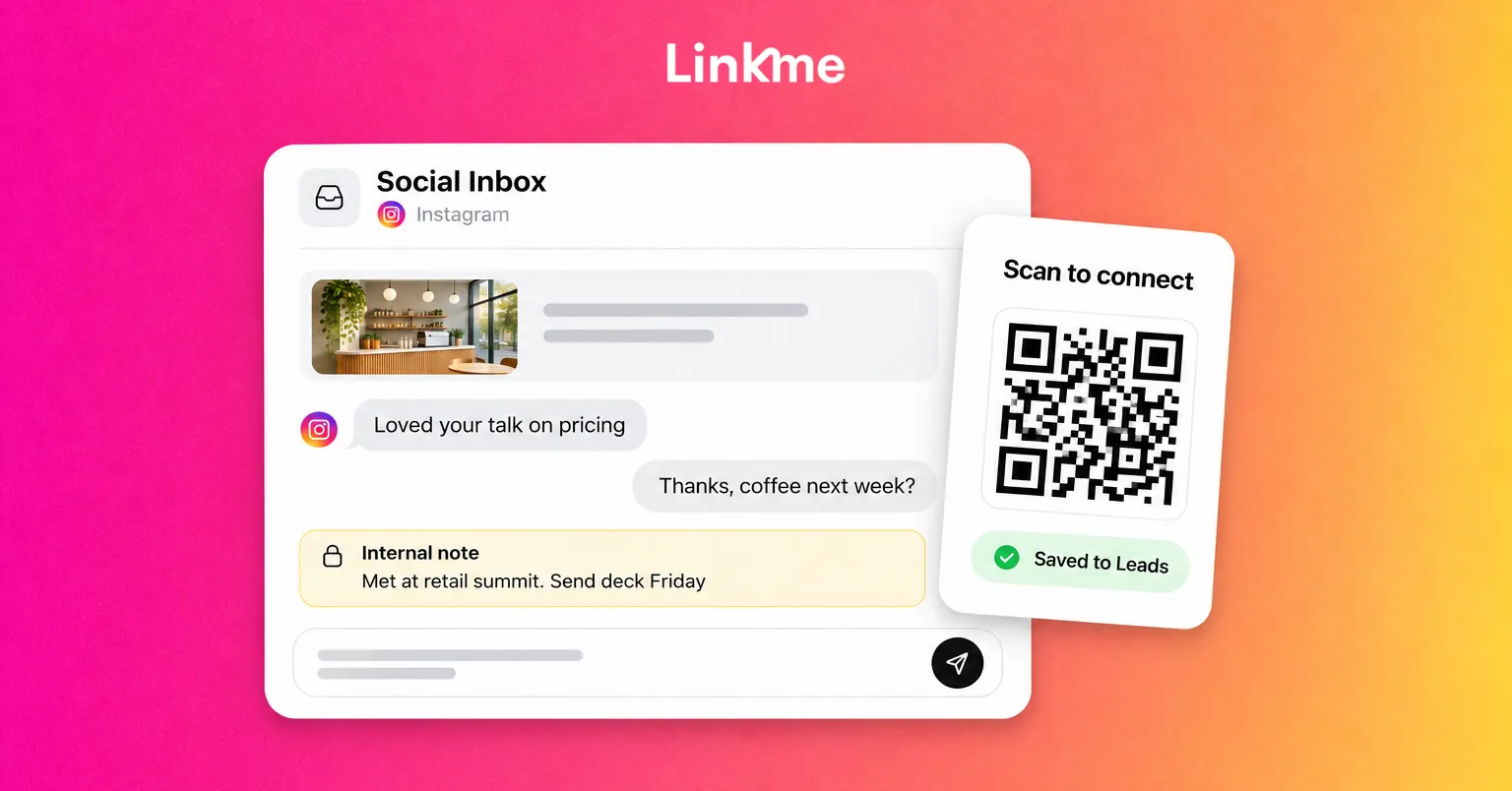
For a business, conversations often pass between people. A community manager answers a comment, a colleague picks up the DM the next day, and a partner inquiry sits for a week because nobody knew the history. Linkme’s Social Inbox brings Instagram and Facebook comments and DMs into one place, shows the post behind every comment, and lets the team leave internal notes in the thread that the customer never sees. The next person signed in to the account reads the note and replies with the full picture. Saved replies help with common questions, but personal relationships deserve a written reply, so use them as a starting point and edit.
Move from DMs to email or a call
DMs are good for starting. Email and calls are better for anything with detail: a project, a partnership, a hiring conversation.
Signs it is time to move:
- You have exchanged more than a few messages on the same topic.
- There is a shared reason to talk: a project, an event, a mutual introduction.
- The conversation needs files, dates or more than one person.
How to ask without pressure:
- Tie it to the reason: “Easier to share the brief by email.”
- Offer a specific option: “Would a 15-minute call on Tuesday or Wednesday work?”
- Make it easy to say no: “If DMs are easier for you, that’s fine too.”
After the call, send a short email with what you discussed and the next step. That message becomes the record you both refer back to.
Meet in person with a QR code to hand
Meeting in person is where many online connections become real relationships, and also where many of them are lost. You talk for ten minutes, swap handles, and the connection never goes further.
Have one link ready that holds your work, your contact details and your socials, and a QR code that opens it. A Linkme page has its own QR code that always opens the live page, so you can show it on your phone or print it on a badge or card and keep updating the page afterward.
Make it easy for the other person to leave their details too. A Connect with button or a form on your Linkme page saves each person who signs up to Leads with the place they signed up, as described on Lead capture. Follow up within a day while the conversation is fresh, and mention one specific thing you discussed.
Turn followers into relationships
For creators and brands, networking also happens in your own comments. The people who reply to every post, share your work and send thoughtful DMs are the start of a community.
- Learn the names of repeat commenters and reply to them by name.
- Answer questions in DMs fully, not only with a link.
- Invite your most engaged followers to your email list, where you can talk to them directly without depending on a feed.
- Ask for their input on what you make next, and credit them when you use it.
Frequently asked questions
How do you turn virtual networking into real relationships?
Start with a specific, short message that asks for something small, follow up with something useful, keep notes on each conversation and move to email, a call or an in-person meeting once there is a shared reason to talk at length.
How do you send a networking DM without being spammy?
Reference something real the person made or said, introduce yourself in one sentence, ask one easy question and leave links out of the first message. Write each message for the person, never as a copy and paste.
How soon should you follow up after meeting someone?
Within a day for the first follow-up, while the conversation is fresh. Then follow up every few weeks or months with something useful for them, not a request.
How can a business keep track of conversations with customers and partners?
Keep conversations in one shared inbox with internal notes, so anyone on the team can see the history before replying. Log key partner conversations with next steps, and move longer discussions to email.