How to Boost Organic Reach on Every Social Network
Organic reach comes from native, original posts, strong hooks, shareable formats and steady consistency. Here is a weekly routine to grow reach without ads.
On this page
- Key takeaways
- What organic reach is, and why it moves
- Make every post native to the network it lands on
- Write hooks that earn the next few seconds
- Create posts people share and save
- Time posts for your audience, then test
- Stay consistent without burning out
- Keep the conversation going after you post
- Use feedback to decide what to post next
- Frequently asked questions
To boost organic reach, publish original content in each network’s native format, open every post with a hook that earns the next few seconds, give people a reason to share or save, and keep a pace you can sustain for months. Reach without ads comes less from tricks than from repeated, small improvements in what you post and when. This guide turns those principles into a weekly routine you can run across Instagram, TikTok, YouTube, LinkedIn and the rest from one place.
What organic reach is, and why it moves
Organic reach is the number of unique people who see your content without paid promotion. On most networks today, a large share of what people see comes from recommendation feeds rather than from accounts they follow, so a post can reach far beyond your follower count or barely reach your own audience.
You cannot control the ranking system, but you can control the inputs it reads: what the post is, how people react in the first hours, and whether you keep showing up. The tactics below focus on those inputs.
Make every post native to the network it lands on
Format and framing
The same idea usually needs a different shape on each network. A vertical video for Reels, TikTok and YouTube Shorts, a carousel or text post on LinkedIn, a short text post on X or Threads. Check what each format supports before you edit: carousel sizes and caption limits differ widely between networks.
| Network | What tends to travel | Practical note |
|---|---|---|
| Reels, carousels people save | Original video, no other app’s watermark | |
| TikTok | Short vertical video with a fast hook | Native sound and on-screen text |
| YouTube | Shorts plus longer videos that answer a search | Clear title and first frame |
| Text posts and document-style carousels | Lead with a specific observation | |
| X and Threads | Short, opinionated text | Fit the character limit without cutting meaning |
Original over reposted
Instagram says it favors original content in recommendations and is less likely to recommend reposts of reels already on the platform, content with visible watermarks or accounts that mainly aggregate other people’s posts. Its help center on original content also makes clear that light edits to someone else’s video do not turn it into original content. Export clean files from your editor rather than downloading a post from one app and uploading it to another.
One composer, adjusted per network
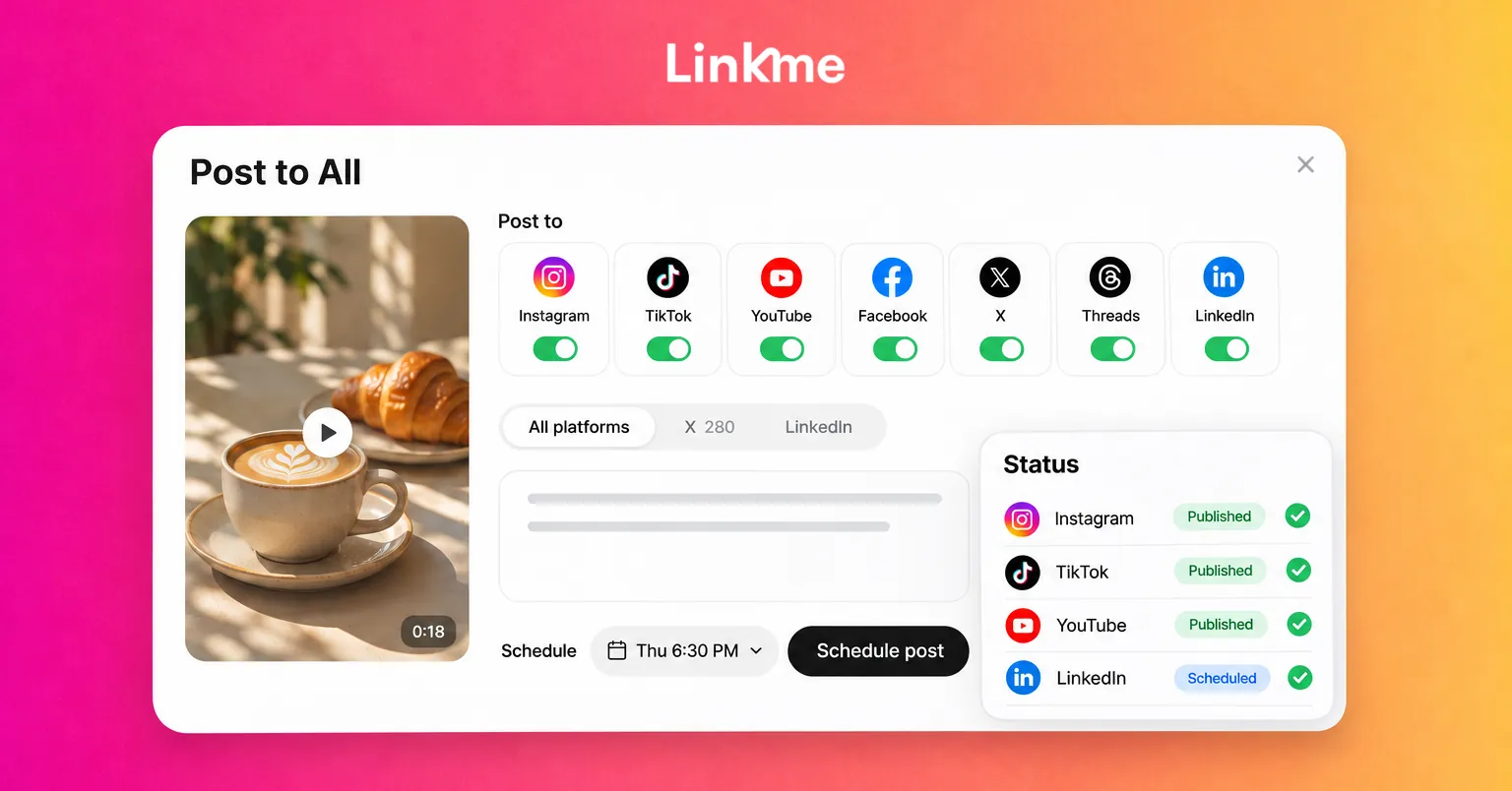
Publishing natively does not have to mean opening seven apps. With Linkme’s Post to All, you upload a video, image or carousel once, write one caption, then open a network’s tab when it needs its own version. Each caption is checked against that network’s limit as you type, from 280 characters on X to 5,000 on YouTube. You pick the networks, publish now or schedule, and see a status for each one, with a retry for any network that misses. If you want a deeper walkthrough of adapting one post for several networks, read the guide on how to cross-post on social media.
Write hooks that earn the next few seconds
Most posts lose people at the start. Treat the hook as its own piece of work:
- State the payoff. “Three ways to cut your menu photos’ editing time” tells the viewer what they get.
- Show the result first. Before and after, the finished dish, the final score. Then explain how.
- Start mid-action. Skip the greeting and the logo intro.
- Use on-screen text. Many people watch without sound; the first line of text should stand alone.
- Match the caption’s first line to the video. On feeds that truncate captions, the opening line is the hook.
Write three hooks for each post and pick the strongest. Keep a running list of hooks that worked so you can reuse the pattern, not the words.
Create posts people share and save
Likes are the cheapest reaction. Shares, saves, replies and rewatches show that a post was worth something to the viewer, and they put it in front of new people when someone sends it to a friend.
Formats that tend to get shared or saved:
- Checklists and step-by-steps someone will want later (“save this for your next launch”).
- Specific opinions on a debate in your field, with a reason.
- Behind-the-scenes that answers a question customers actually ask.
- Local or niche references that make a viewer think of one particular person.
- Answers to comments, turned into their own short post.
Ask for the specific action when it fits: “Send this to whoever handles your bookings” is more useful than “Like and follow.”
Time posts for your audience, then test
There is no universal best time to post. Start with when your audience is awake and scrolling in their own timezone, then compare results across a few slots over several weeks. Keep the slot steady while you test other variables, or you will not know what caused a change.
If you serve several regions, schedule separate versions or posts for each audience’s local time rather than picking one compromise slot. A shared social media calendar keeps those slots visible so a team does not double-post or leave gaps.
Stay consistent without burning out
Ranking systems learn what your account is about and who responds to it. Long gaps reset that learning, and bursts of low-effort posts teach it the wrong things.
A sustainable baseline for a small team:
- One batch session a week to film or design several posts.
- One core idea per week, adapted into a video, a carousel and a text post.
- A fixed review slot to check last week’s results before planning the next.
Pick a frequency you could hold through your busiest month. It is easier to add a post than to explain three weeks of silence to the people who used to see you every day.
Keep the conversation going after you post
Replies in the first hour give the network more to work with and show new viewers that the account is active. Answer real questions, pin a useful comment and turn good questions into future posts.
When a post invites a response such as “comment GUIDE and we’ll send it,” a DM automation can reply to the comment and send a DM with your link, so nobody waits hours for an answer and the comment thread stays active.
Use feedback to decide what to post next
Each week, look at your posts by network and ask three questions:
- Which posts reached the most non-followers?
- Which ones were shared or saved most relative to views?
- Which hooks held attention past the first few seconds?
Then change one thing: the hook style, the format or the posting slot. On Instagram, trial reels let eligible professional accounts show a reel to non-followers first and decide later whether to share it with followers, which is a low-risk way to test a new style.
Frequently asked questions
Why is my organic reach dropping?
Common causes are posting less often, reusing content with another app’s watermark, formats that do not fit the network, or hooks that lose viewers early. Compare your recent posts with ones that performed well and look for what changed before assuming the network penalized you.
How can I increase organic reach on Instagram?
Post original Reels and carousels, write a clear hook for the first seconds and the first caption line, and aim for shares and saves rather than likes. Reply to early comments, and use trial reels to test new ideas with non-followers before showing them to your followers.
Is it still possible to grow without ads?
Yes. Recommendation feeds can show a post to many people who do not follow you, so useful, native, original content can grow an account without paid promotion. Ads can speed up testing, but they do not replace content people want to share.
How often should I post to grow organic reach?
Choose a pace you can sustain for at least a few months, then increase it if quality holds. Consistency over time usually matters more than daily volume, and one strong idea adapted for several networks often outperforms several rushed posts.
Linkme brings the routine into one place: one composer for every network, a caption per network when you need it, scheduling and a status for each post. See how Post to All fits your weekly workflow.