How to Build a Twitch Community That Keeps Coming Back
A Twitch community grows from a schedule people can plan around, chat rituals, trusted moderators, a Discord server and clips that bring new viewers in.
On this page
- Key takeaways
- Start with a schedule people can plan around
- Give chat rituals that make regulars feel at home
- Build a moderation team before you need one
- Give the community a home between streams
- Use clips on short-form networks to bring in new viewers
- Set up a streamer home page that ties it together
- Frequently asked questions
A Twitch community is the group of people who come back stream after stream, know each other in chat and show up when you go live. You build one with a predictable schedule, chat habits regulars can join in on, moderators who keep the room safe, a place to talk between streams and clips that bring new people in. This guide works through each of those, then shows how to set up one home page that connects them.
Start with a schedule people can plan around
People can only become regulars if they know when to find you.
Twitch has a built-in stream schedule in the Creator Dashboard, under the channel settings. Each segment takes a title, a category, a start time and a duration, and you can set segments to repeat on chosen weekdays. There is also a vacation setting, so viewers see that you are away instead of wondering where you went. Menu names change from time to time, so look for “Schedule” in your dashboard if the path has moved.
Choose slots you can keep for months. Two fixed nights beat five that move around.
| Your available time | A schedule that holds up | Why it works |
|---|---|---|
| A few hours a week | Two fixed evenings, same start time | Easy to remember, easy to protect |
| Part time | Three slots, with one themed night | The theme gives people a reason to show up on that day |
| Full time | Four or five slots, with one recurring “community” stream | Regulars get a session built around them |
Give each slot a short title (“Viewer games Friday”), and post cancellations before the start time, in the same places every time.
Give chat rituals that make regulars feel at home
Communities form around shared habits that a newcomer can pick up within one stream.
- A consistent opening. Greet chat by name for the first few minutes, recap what happened last stream and say what is planned today.
- Recurring segments. A weekly viewer-games night, a monthly “rate my setup”, a regular charity or challenge stream. Put them in your schedule titles.
- A community name and in-jokes. Let the name come from chat rather than forcing one. Once you have custom emotes, build them around those jokes.
- Recognition. Thank people for follows and subs, but also call out the regulars who help new viewers, share clips or make fan art.
- A clear close. End with what is coming next stream and where to find you in between.
Rituals are the culture of the channel. The tools you use during a stream to keep chat active, such as polls, predictions, channel points and raids, are a separate topic and work best once these habits exist.
Build a moderation team before you need one
A community grows only if people feel safe in it. Moderation is easiest to set up while the channel is still small.
- Write your rules. Keep them short and put them in a panel under the stream, where moderators can point people to them. Include what gets a warning, a timeout and a ban.
- Choose moderators from your regulars. Look for people who already welcome newcomers and stay calm. Start with one or two, and add more as chat gets busier.
- Give them a short guide. Who to time out, when to ban, which topics to steer away from and how to reach you during a stream.
- Set up AutoMod. Twitch’s AutoMod holds risky messages for a moderator to approve or deny before chat sees them. You choose a filtering level and can add blocked and permitted terms.
- Know where Shield Mode is. Shield Mode applies a stricter preset of chat settings in one step during harassment or a hate raid, and returns chat to your usual settings when you switch it off.
- Review together. Check in with your mods every few weeks about what is working and what needs a new rule.
Give the community a home between streams
A Twitch community that only exists while you are live is easy to lose. A Discord server lets people keep talking, share clips and organize games when you are offline.
Discord has a Twitch integration. Once you connect your Twitch account and add the integration to your server, it creates subscriber roles that sync automatically, so you can give subscribers their own channels or colors. Viewers who link their Twitch account can see and join the servers of channels they subscribe to.
Keep the server simple at first:
- #announcements for go-live alerts and schedule changes
- #general for conversation
- #clips where members share moments from streams
- #rules that match your Twitch rules
- One channel for your main game or topic
Add channels only when one gets crowded, and ask your Twitch moderators to cover Discord too, so the rules feel the same in both places.
Use clips on short-form networks to bring in new viewers
Many viewers find a new streamer through a clip on TikTok, YouTube Shorts or Instagram Reels, then go looking for the stream.
Twitch clips can run up to 60 seconds, and Twitch’s clip editor can produce a portrait version for vertical feeds, with layouts that keep your camera and gameplay in frame. That often saves a separate editing step.
A routine that works:
- After each stream, pick two or three moments: a funny reaction, a clutch play, a good exchange with chat.
- Trim each one so it starts with the payoff or the setup in the first seconds.
- Write a caption that says what happened and when you stream (“Live Tue and Thu, 8 PM ET”).
- Post the same clip to several networks, with captions adjusted for each.
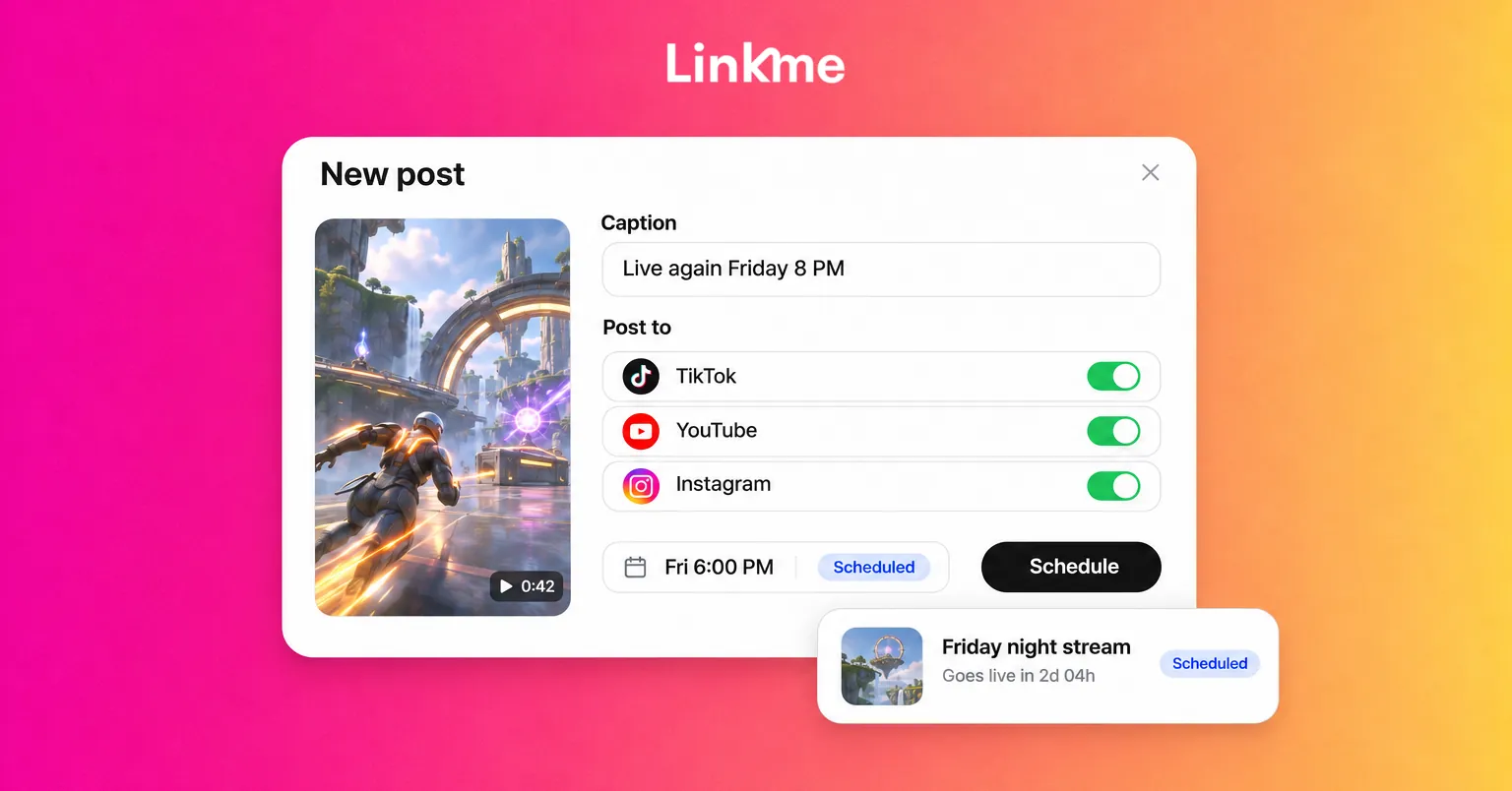
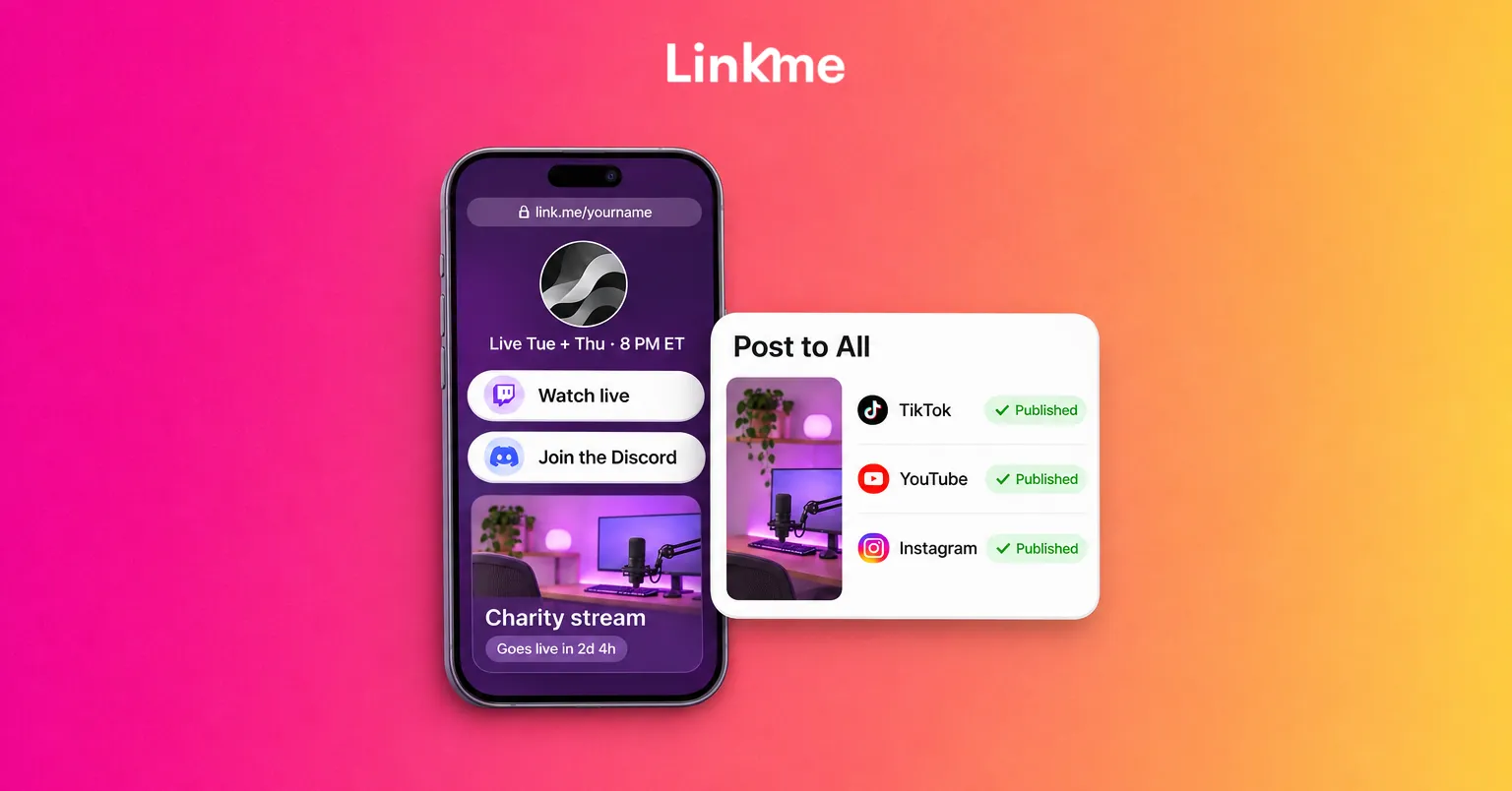
Post to All handles the last step. Upload a clip once, write one caption or one per network, and publish or schedule it to your connected YouTube, Instagram, TikTok, Facebook, X, Threads and LinkedIn accounts, with a status for each network and a retry if one misses. Twitch itself is not one of the publishing networks, so you clip on Twitch and post the clips everywhere else. For YouTube timing and formats, see how to schedule YouTube Shorts.
Set up a streamer home page that ties it together
Your Twitch bio, your clips and your Discord all need to point somewhere. A single page that holds every link stops new viewers from getting lost between networks.
On a Linkme page, a streamer home page might hold:
- Your Twitch channel first, as a large featured link
- Your schedule, in your bio or as a header, so it is visible before anyone taps
- Your Discord invite
- Your latest videos, using a video feed from YouTube, TikTok or Instagram
- An email sign up, so you can reach your community even if a platform changes
- Merch or tips, if you sell anything
For a special stream, such as a charity marathon or a launch, the Link Scheduler on Plus and Pro lets a link go live at a set time with a countdown on your page. The page also has its own QR code, which is useful on a convention badge or a stream overlay.
Linkme analytics show which links people tap and which countries and cities they come from, which helps when you choose stream times. Streamers, creators and athletes run their page, posts and sales together on Linkme; see how on the creators and athletes page.
Frequently asked questions
How long does it take to build a Twitch community?
Expect months rather than weeks. Most communities form slowly around a reliable schedule and a few regulars. Measure progress by returning chatters and Discord activity, not only by viewer counts.
Should a small streamer start a Discord server?
Yes, once a handful of people come back regularly. A small, active server is better than a large empty one. Start with a few channels and add more only when people ask for them.
How many moderators does a Twitch channel need?
One trusted moderator is enough for a small channel, especially with AutoMod switched on. Add moderators as chat speeds up or when you stream at times your current team cannot cover.
Do clips on TikTok and YouTube Shorts actually grow a Twitch channel?
They are one of the most reliable ways for new people to discover you, because short-form feeds show your best moments to people who do not follow you yet. Always tell viewers in the caption or on your page when and where you stream.
A Twitch community is built one regular at a time. Keep the schedule, protect the room and give people a clear way back. When you are ready, claim your Linkme page and put every link in one place.