Social Media for Eco-Friendly Lifestyle Brands: Credible Claims and Content Ideas
Sustainable audiences spot vague claims fast, and the rules have tightened. How eco brands can make specific, provable claims, find content that shows the work, build community and cut print waste.
On this page
Eco-friendly lifestyle brands earn attention on social media by showing specific, provable changes, not by calling themselves green. The audience for sustainable products is often well informed and quick to spot vague claims, and regulators in the US, the EU and elsewhere expect environmental claims to be specific and backed by evidence. This guide covers how to make credible claims and avoid greenwashing on social media, content ideas that work for eco brands, how to build a community around your values and practical ways to cut waste in your own marketing.
Why sustainable brand marketing is held to a higher standard
Eco-friendly lifestyle brands sell partly on values. That makes trust the product. A single claim that turns out to be vague or wrong can undo years of goodwill, and it is easy for followers to screenshot and share.
The rules have also tightened:
- In the US, the FTC’s Green Guides say marketers should not make broad, unqualified claims that a product offers a general environmental benefit, because such claims are very hard to substantiate. Claims should be qualified and focused on a specific attribute you can support.
- In the EU, Directive (EU) 2024/825 on empowering consumers for the green transition applies from 27 September 2026. It restricts generic environmental claims such as “eco-friendly” or “green” unless strict conditions are met, and it can reach brands outside the EU whose claims are aimed at EU consumers.
Social posts, captions, videos and creator content all count as marketing. If a claim would be a problem on your packaging, it is a problem in a Reel.
Avoiding greenwashing on social media
Swap broad claims for specific ones
| Vague claim | Specific alternative |
|---|---|
| Eco-friendly packaging | Shipping box made from recycled cardboard, with no plastic tape |
| Sustainable fabric | Made with organic cotton, certified by [name the certifier] |
| Carbon neutral | We cut delivery emissions by switching routes; here is how we measured it |
| Clean ingredients | A full ingredient list, with the role of each one |
| Better for the planet | Refill pouches use less material than buying a new bottle |
The specific version is less catchy, but it is far more persuasive to people who care, and it is easier to defend.
A claim checklist before you post
- Is it specific? Name the part of the product or process the claim is about.
- Is it true for the whole product? If only the lid is recyclable, say the lid.
- Can you prove it today? Keep test results, certificates or supplier documents on file.
- Is the comparison fair? “Less plastic” needs a clear baseline: less than what?
- Do the images match? Leaves, forests and green tints can imply a general benefit the text does not support.
- Does it rely on offsetting? Avoid saying a product is “carbon neutral” or has a reduced impact because of offsets. Under the EU rules, product claims like that are banned when they rest on offsetting.
- Would an expert follower agree? If not, rewrite it.
Apply the same rules to creators
If you work with creators or ambassadors, include your approved claims in the brief and list the claims they must not make. A creator saying “this is the most sustainable brand out there” is still your marketing.
Eco brand content ideas
Content that shows the work builds more trust than content that states values. Ideas that suit sustainable brands:
- Supply chain stories: a short video from a supplier visit, with what you learned and what you are still working on.
- Material explainers: a carousel on why you chose one material over another, including the trade-offs.
- Repair and care guides: how to make the product last longer. This is useful, shareable and consistent with your message.
- Refill and return how-tos: step-by-step guides for any refill, take-back or recycling scheme you run.
- Progress updates: what you set out to change, what has changed and what has not. Admitting a miss builds credibility.
- Customer routines: with permission, real customers showing how the product fits into their routines.
- Myth-busting: answer common questions honestly, including “is this actually better?”
Keep a mix: roughly half practical help, a quarter behind the scenes and the rest product and offers. Adjust based on what your audience saves and shares.
Building community around your values
Answer questions in public, with sources
People will ask where something is made, what a material is and how to recycle packaging. Treat each question as content: answer it in the comments, then turn the most common ones into a post or a highlight. A social inbox that brings Instagram and Facebook comments and DMs together, with saved replies for the questions you get every day, helps you answer consistently and link to the page with the evidence.
Give people something to do
Community grows around shared action. Invite followers to:
- Share how long they have used a product.
- Join a repair or swap event.
- Sign up for refill reminders or seasonal care tips.
Put the sign-up and the details on one page. On Linkme, a page can hold links, events, videos, products and an email sign up, so a post can send people to one place for the next step.
Partner with local and like-minded groups
Co-hosting a beach clean-up, a repair café or a talk with a local group gives you real stories to share and introduces you to people who already care. Be clear about your role and avoid implying the partner endorses your products unless they do.
Cut waste in your own marketing
Eco-friendly lifestyle brands are judged on their own operations, including marketing. Printed flyers, table cards and signs that need reprinting each time a link or offer changes create avoidable waste.
Print one QR code that stays current
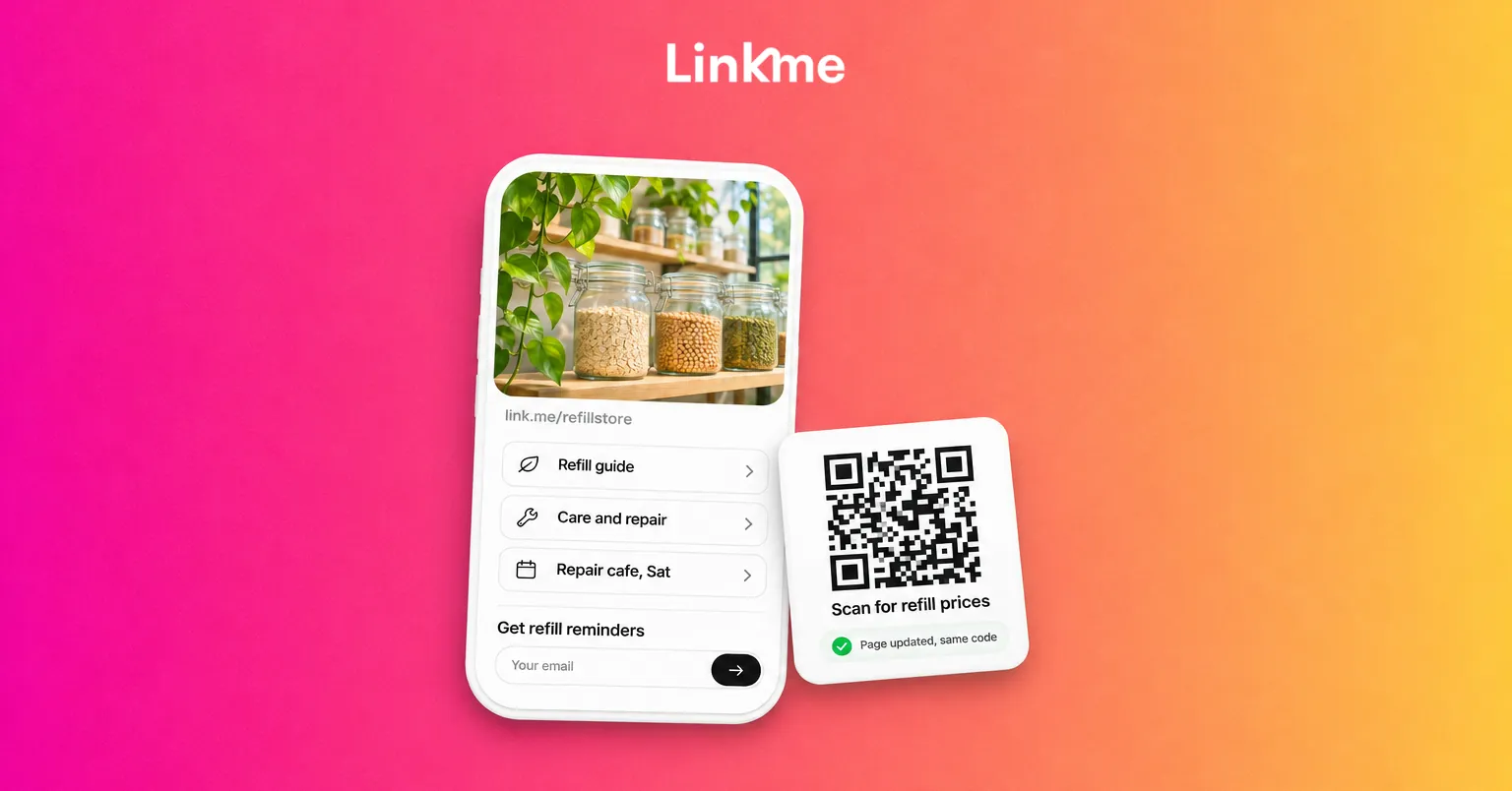
With Linkme Pages & QR, each page has its own QR code that always opens the live page. Change the page any time and the printed code keeps working, so a sign in a shop, a tag on a product or a card at a market stall does not need reprinting when the season, the event or the offer changes.
Practical uses for sustainable brands:
- A QR code on swing tags that opens care and repair instructions.
- A code at the refill station that opens the refill guide and current prices.
- A code at a market stall that opens your events and an email sign up.
You can also give a link a start and an end date, so a seasonal offer goes live on its own and comes off when the window closes. Each scan is a visit that counts in your page’s profile views, and the links people tap count as link clicks.
Reuse content across networks
Producing one strong video and publishing it to several networks uses fewer resources than shooting separate content for each. Adapt the caption for each network rather than reshooting.
Frequently asked questions
How can eco-friendly brands avoid greenwashing on social media?
Use specific claims about a named part of the product or process, keep evidence on file, avoid broad terms like “eco-friendly” without proof and make sure images do not imply more than the text supports. Brief creators on approved claims too.
Can I still use the word “eco-friendly” in marketing?
Broad claims like “eco-friendly” are risky. US guidance discourages unqualified general environmental claims, and EU rules applying from 27 September 2026 restrict them unless strict conditions are met. A specific, qualified claim is safer and more convincing.
What content works best for sustainable brands on social media?
Practical and transparent content: repair and care guides, material explainers, supply chain stories, honest progress updates and how-tos for refill or take-back schemes.
How can a brand reduce print waste in its marketing?
Use a QR code that always opens a live page, so printed signs, tags and cards stay accurate when links or offers change, and reuse one piece of content across several networks.
To see how brands run their pages, posts and QR codes from one place, explore Linkme for business.