Procrastination for Content Creators: Why It Happens and How to Stop
Creators put off content to avoid a feeling: the blank page, a possible flop or a task too big to start. Smaller first steps, AI first drafts, batch days and scheduled deadlines help.
On this page
Procrastination for content creators rarely looks like laziness. It looks like reorganizing your files, rewatching other people’s videos “for research” and telling yourself you will film tomorrow when the light is better. Underneath it is usually a feeling you are trying to avoid: the blank page, the fear that the post will flop, or a task so big you cannot see where to start. The fix is to make the first step smaller, never start from nothing, and put deadlines where you cannot ignore them.
Why creators procrastinate
Psychologists who study procrastination describe it as a mood problem more than a planning problem. Putting a task off gives you short-term relief from the discomfort it causes, and that relief is what keeps the habit going. For creators, a few triggers come up again and again.
Perfectionism
When every post feels like a public test, starting means risking something that is not good enough. It feels safer not to start. Perfectionists often have dozens of ideas in their notes app and very few finished posts.
The blank page
An empty caption box or an empty editing timeline asks you to make every decision at once: the angle, the hook, the format, the words. That is tiring before you have done anything, so the brain looks for something easier.
Tasks that are too big
“Film this week’s content” is not a task. It is a project with a dozen steps. When the next step is not obvious, you will choose a task that is, like answering messages.
Feedback you can see
Creators get a scoreboard on every post. A video that underperforms is visible, and the memory of it makes the next one harder to start.
Too many choices
Seven networks, five formats, and endless trend audio. Without a few fixed rules, every post starts with a decision, and decisions are where the delay begins.
Make the first step smaller
The single most reliable fix is to shrink the next action until it feels almost too easy. Instead of “film a video,” try:
- Write three possible hooks.
- Pick one and write the first line of the caption.
- Set up the camera and record one take, even a bad one.
- Trim the take to the first 15 seconds.
Once you have started, momentum usually carries you further. If it does not, you still made progress.
A short timer helps too. Commit to 15 or 25 minutes on the one task, with your phone in another room. Stopping when it ends is allowed. Most of the time you will not want to.
Never start from a blank page
Editing is easier than writing. A rough first version, even one you rewrite completely, turns “what do I say?” into “what would I change?”, and that is a much smaller question.
Ways to avoid the blank page:
- Keep a running idea list with one line per idea, captured the moment you have it.
- Reuse a structure: a hook, three points and a call to action works for most short videos and captions.
- Talk it out: record a voice memo explaining the idea to a friend, then write from the transcript.
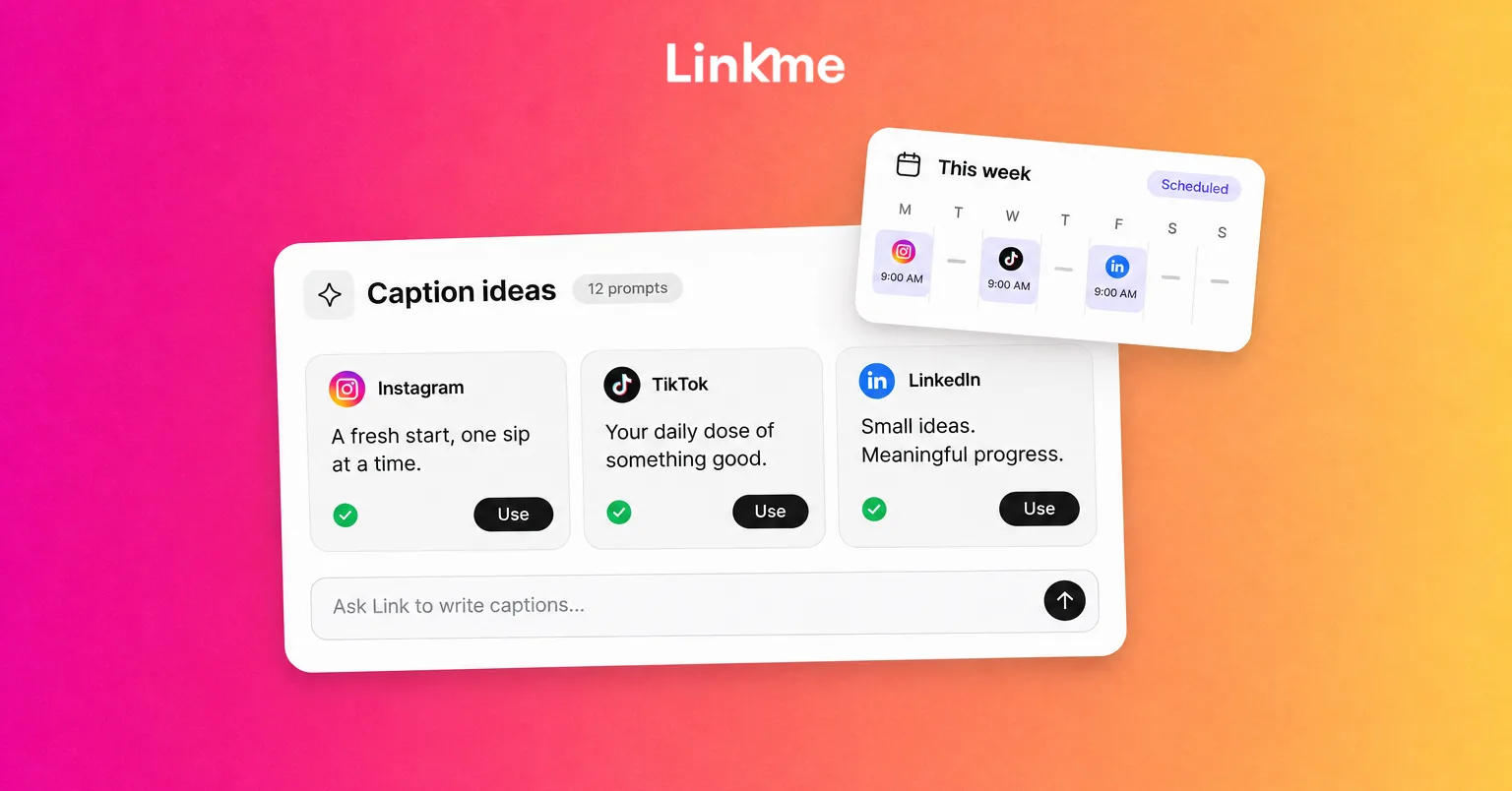
- Ask an AI for a first draft. Give it the topic, your audience and the tone, then edit the result into your own voice.
Let Link draft the first version
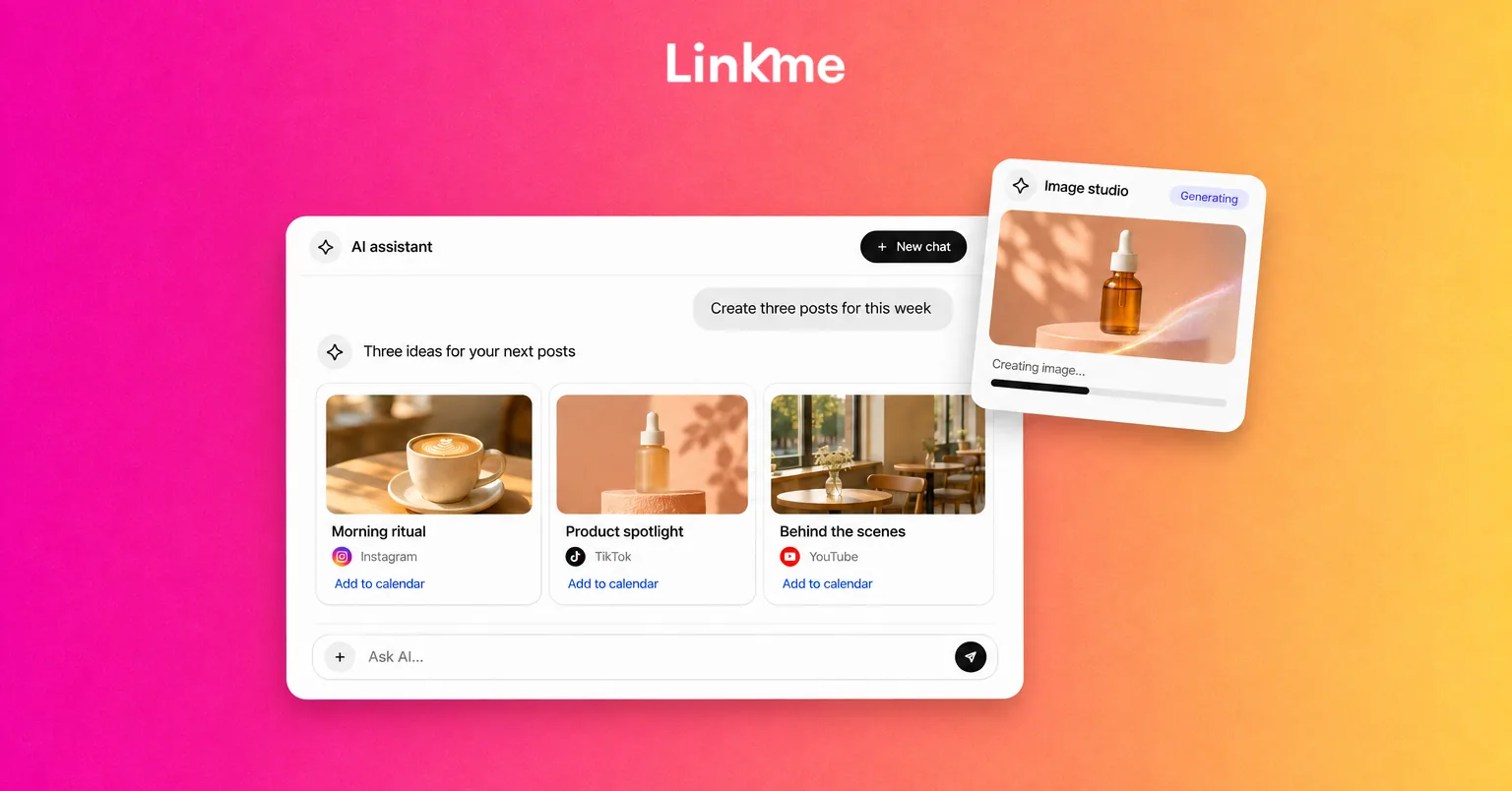
Link, Linkme’s AI social media manager, drafts posts and makes the images and videos to go with them. In the Post to All composer, Write with Link writes the caption for you to edit. You can type your request or say it in a voice chat, which helps on days when even typing feels like too much.
The important part for perfectionists is that nothing goes live until you approve it. The draft is a starting point, not a commitment. You can rewrite every word, and you still saved yourself the hardest minute of the task. If you want better first drafts, specific prompts make a big difference; our guide to AI prompts for social media has examples you can adapt.
Batch the work you dread
Context switching feeds procrastination. Every time you move from editing to messages to planning, you have to restart, and every restart is a chance to drift.
A batch day groups the same kind of work together:
| Block | What you do | Done when |
|---|---|---|
| Plan | Pick the week’s topics from your idea list | Every slot has a topic |
| Draft | Write or generate first drafts of every caption | Every post has a rough caption |
| Record | Film everything in one setup | All clips recorded |
| Edit | Cut, caption and export | All files ready |
| Schedule | Load everything into your calendar | Every post has a date and time |
You face the hard part once a week instead of every morning. On the other days, your only job is to show up for comments and messages.
Put deadlines where you cannot ignore them
Self-set deadlines are easy to move. Deadlines that other people or systems can see are not.
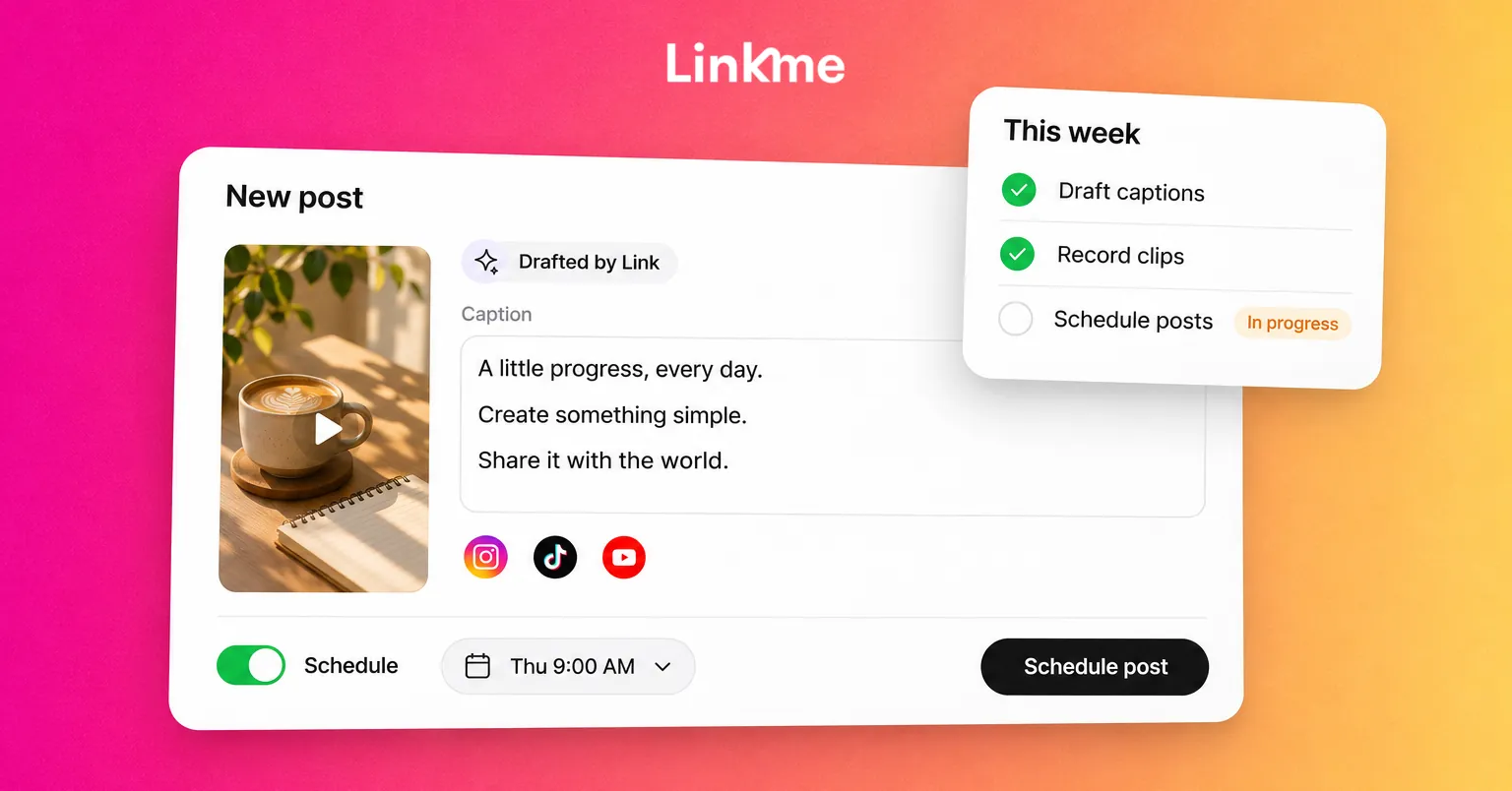
- Schedule the post before it is finished. Put a placeholder in your calendar for Thursday at 9:00 AM. An empty slot with a date is a clear prompt.
- Work backwards. If it posts Thursday, the edit is due Wednesday and the recording Tuesday. Put those in your calendar too.
- Tell someone. A manager, an editor or a creator friend who expects to see the draft makes the deadline real.
With Post to All, you upload once and schedule the post to YouTube, Instagram, TikTok, Facebook, X, Threads and LinkedIn for a date and time. Every scheduled post waits in the Plan calendar with its status, so your week is visible at a glance and a gap is obvious. If you are building a calendar from scratch, our social media calendar guide includes a template.
Lower the bar for “done”
Perfectionism needs a definition of good enough. Write one down and use it as a checklist:
- The first second gives a reason to keep watching.
- The main point is clear.
- Captions or on-screen text are readable.
- There is one call to action.
If a post meets all four, it ships. You can improve the next one using what this one teaches you. A posted video that is 80 percent of what you imagined beats a perfect one that lives in your drafts.
Be kind to yourself after a slip
Research on procrastination suggests that people who forgive themselves for putting something off are less likely to do it again, while harsh self-criticism makes the task feel even worse next time. Missed a week? Skip the guilt, pick the smallest next step and do it today.
Frequently asked questions
Why do I procrastinate on content I enjoy making?
Enjoying the work does not remove the discomfort of starting it. The blank page, the fear of a flop and too many choices all show up even for topics you love. Shrinking the first step and starting from a draft help most.
Is it cheating to use AI for a first draft?
No, as long as the final post is yours. Use the draft to get past the blank page, then rewrite it in your own voice, check the facts and cut anything that does not sound like you.
How far ahead should I schedule content?
Start with one week. That is enough to remove daily pressure without locking you into posts that go stale. Extend it once batching is a habit.
What if batching makes me burn out?
Make the blocks shorter or spread them across two days. The goal is fewer restarts, not one exhausting marathon.