How Brands Can Engage Gaming Communities Authentically
Gamers spot a forced sponsorship in seconds. Here is how brands choose gaming creators who fit, brief them, respect community norms, run fair giveaways and measure results.
On this page
The brands that engage gaming communities well show up through creators the community already trusts. They follow the community’s norms and give players something worth having, rather than dropping an ad into the middle of it. Gamers spot a forced sponsorship within seconds, and live chat tells you at once. This guide covers choosing gaming creators who fit, writing a brief they can work with, respecting how gaming communities behave, running giveaways properly and measuring what matters.
Why gaming communities push back on brands
Gaming audiences spend hours with the creators they watch. They know the in-jokes, the running bits and when the streamer is sincere. A sponsorship that breaks that flow, such as a stiff scripted read in the middle of a ranked match, gets mocked in chat in real time and clipped afterward.
That same closeness works in a brand’s favor when the partnership fits. When a streamer the community trusts actually uses a product, explains why and jokes about it in their usual way, the recommendation carries weight a polished ad can’t match. The aim is to earn that trust, not to borrow attention.
Start with fit, not follower count
A creator with a smaller, engaged audience in the right game often does more for a brand than a much larger general channel. Check these before you reach out:
| What to check | Why it matters | How to check it |
|---|---|---|
| Games and genre | A headset matters to competitive shooter players. A cozy-game audience may care more about desk setups. | Watch recent streams and VODs, not just highlight clips. |
| Audience | Age, country and platform decide who your message reaches. | Ask the creator for audience data from their dashboards. |
| Tone and chat culture | Your brand will sit next to the chat as well as the creator. | Watch a full stream and read the chat. |
| Past sponsorships | Too many recent deals can tire the audience. Good past deals show the creator knows how to integrate one. | Scroll back through recent videos and streams. |
| Consistency | A steady schedule means steady exposure for your campaign. | Look at stream history and posting frequency. |
Treat brand safety as part of fit. Review recent content the way you would review any partner, and agree in writing on what is off limits during sponsored segments.
Brief creators the way gamers would want
A good brief tells the creator what you need and leaves the delivery to them.
- The goal: for example, sign-ups for a beta, sales of a product or downloads of a mod.
- Must-haves: the product shown on screen, the link or code, a clear disclosure and any claims that legal has approved.
- Must-avoids: competitor mentions, claims you cannot support, and anything that conflicts with platform rules.
- Format ideas, not scripts: a challenge run using your product, a segment between matches, a setup tour or a community vote.
- Timing: when the segment runs and how often the link appears in chat.
Ask the creator what has worked with their audience before, and listen to the answer. Let them turn down an idea that won’t land. A creator who knows their community will tell you, and that saves your budget.
Respect community norms
Brands lose goodwill in gaming spaces through small mistakes. Avoid the common ones:
- Don’t interrupt the game. Schedule segments between matches, during breaks or at the start and end of a stream.
- Don’t force the slang. Use the community’s language only where it comes naturally. Overdoing memes reads as trying too hard.
- Ask before you post. In Discord servers and subreddits, read the rules and ask the moderators before you share anything promotional.
- Add something. Early access, in-game items, a tournament prize pool or support for a community event will be welcomed. A banner ad will not.
- Support inclusive spaces. Choose creators who moderate their chat well, and expect that standard during your sponsored segments too.
Disclose every paid partnership
The FTC’s disclosure guidance for influencers applies to gaming creators like anyone else. Free products count as a material connection. In videos, the disclosure belongs in the video itself, not just the description. During live streams it should be repeated so that people who join partway through still see it. Platform labels such as “Paid partnership” help, but the FTC says not to rely on them alone. Put disclosure in your contract and check it in every video.
Run giveaways properly
Giveaways are a common brand activation in gaming, and an easy one to get wrong. Before you announce one:
- Write official rules that cover the sponsor, eligibility, entry dates, how to enter, how the winner is chosen and contacted, and the prize.
- Keep it free to enter. Don’t require a purchase, a paid subscription or a donation to enter.
- Follow platform rules. Instagram’s promotion guidelines require a full release of Instagram by each entrant and a statement that Instagram doesn’t sponsor the promotion. They also prohibit encouraging people to tag content inaccurately.
- Contact winners only from official accounts, and never ask a winner to pay a fee to claim a prize. Scammers copy giveaway posts, so say publicly how winners will be contacted.
For larger prizes, or entries from several countries, have a lawyer review the rules. Sweepstakes laws vary by location.
Measure what matters
Views alone won’t tell you whether a gaming partnership worked. Track:
- Clicks and conversions from each creator’s link or code
- Chat sentiment during the sponsored segment, positive, negative or indifferent
- Watch time and drop-off around the segment, where the creator can share it
- Follow-on content, such as clips, memes or community posts that mention your brand without being asked
Compare creators on cost per useful result, not only on reach. Book the ones who delivered again. A sponsor who comes back is usually better received than one who appears once.
Find gaming creators with Linkme’s creator marketplace
Finding the right creators and handling the outreach is often the slowest part of a campaign. Linkme’s creator marketplace gives that work to Link, Linkme’s AI social media manager.
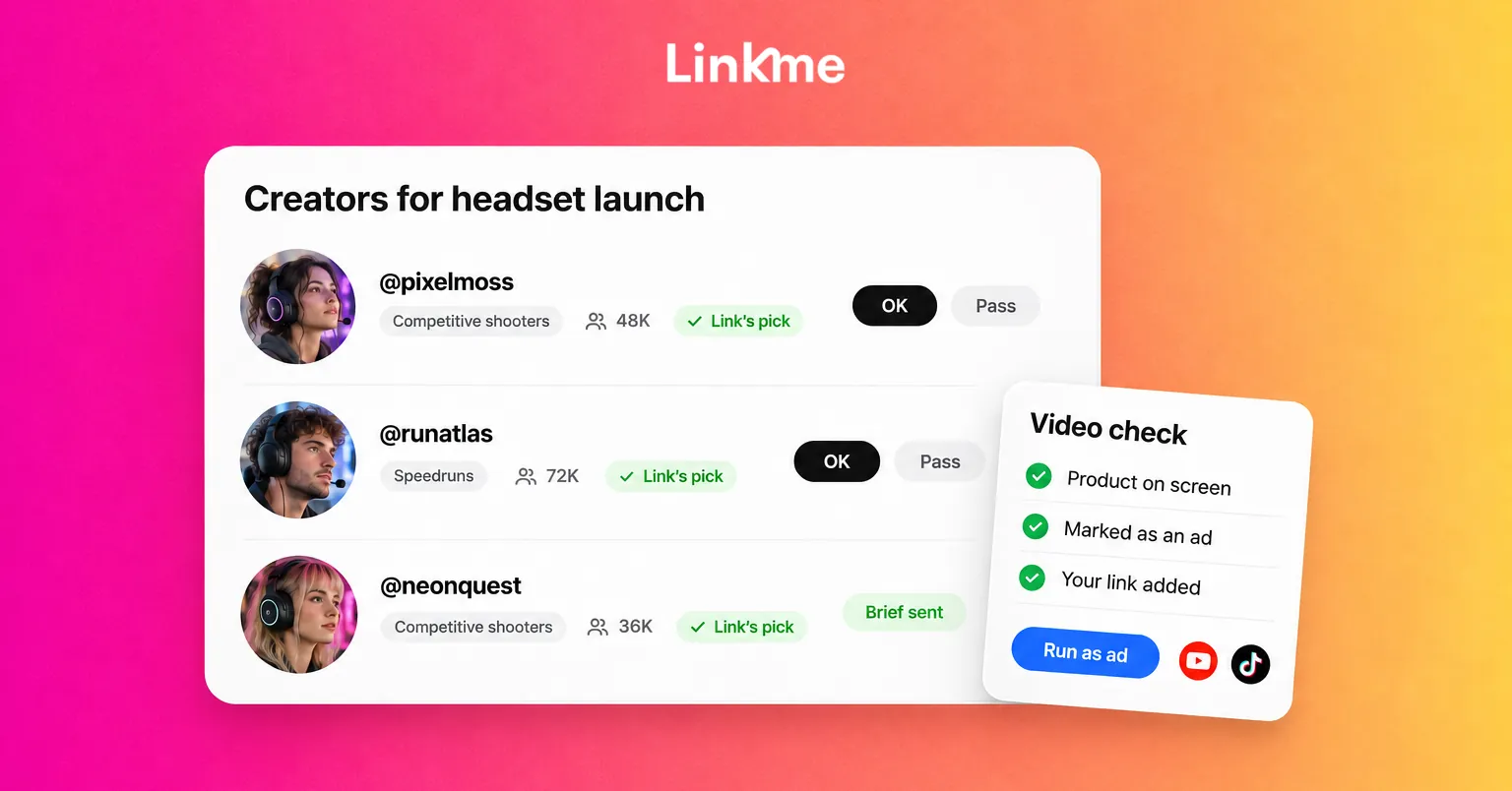
- Tell Link who you need. Write one line, for example “Find gaming creators who stream competitive shooters for our new headset launch.” You can narrow the search by follower count, industry, niche and city.
- See why each creator fits. Link looks at what each creator actually posts and explains its picks before anyone is contacted.
- Approve who gets the brief. Nothing goes to a creator until you approve it. Link then sends your brief, answers questions and agrees the deal. You can read every chat and take over at any point.
- Review the videos. Link checks each video against your brief, including whether it’s marked as an ad and has your link. You keep the ones you like.
- Run the best as ads. Approved videos can run as ads from the same dashboard where you manage your ad campaigns.
The creators in the marketplace run their own pages on Linkme, and the marketplace is part of Linkme for Business.
Frequently asked questions
How do brands engage gaming communities without seeming fake?
Work with creators who already play games your audience cares about, let them integrate your brand in their own style, give the community something of value and disclose the partnership clearly. Avoid scripted reads that interrupt gameplay.
Should brands work with big or small gaming creators?
Both can work. Smaller creators often have closer communities and more chat engagement for the cost, while larger creators bring reach. Many brands run several mid-size creators in one niche and compare results.
Do gaming streamers need to disclose sponsorships?
Yes. The FTC expects clear disclosure of any material connection, including free products. In live streams, the disclosure should be repeated so viewers who join later see it.
How should a brand run a giveaway with gaming creators?
Publish official rules, offer a free way to enter, follow each platform’s promotion rules and contact winners only from official accounts. Never ask a winner to pay to claim a prize.