12 AI Prompts for Social Media Captions and Content Planning
Use 12 AI prompts for social captions and content planning, with a reusable brief, a worked example and a practical review checklist.
On this page
- Key takeaways
- Start with a reusable business brief
- AI prompts for social media captions
- AI prompts for content planning
- AI prompts for revising and checking drafts
- A worked example: from a vague request to a useful draft
- Use the brief in Linkme’s content workflow
- Check the result before you publish
- Frequently asked questions
“Write a post about our business” leaves an AI assistant with most of the decisions still to make. Who is the post for? What should it communicate? Which details are confirmed, and what should someone do next?
A useful social media prompt answers those questions and asks for a specific result. That might be a caption draft, a better opening, ideas from an existing article or a proposed week of content.
Use the brief below with whichever task you need. The twelve prompts are choices, so you can start with one caption or one planning job.
Start with a reusable business brief
Use this brief with Linkme’s AI drafting and planning tools, then add the task you want help with. You can also adapt the instructions to another assistant that supports the task.
Complete the fields relevant to your post. The writing sample is optional; a few clear tone preferences can be enough to start.
Business or service: [What the business does]
Audience: [Who this content should help]
Goal: [What this post or planning task should accomplish]
Channel and format: [Where the content will appear and in what form]
Approved facts: [Confirmed details and any important conditions]
Desired action and destination: [What readers can do and where, or no CTA]
Tone: [Two or three concrete traits]
Optional style example: [Approved writing to use for style only]
Source material or asset description: [Relevant text or what the asset shows]
Length or output preference: [What you need]
Must keep or avoid: [Exact terms, required wording and claims to avoid]

Use the supplied facts. Do not invent missing business details, evidence,
quotes, offers or results. Ask a focused question if an essential fact is
missing. If a provisional draft is useful, mark unresolved details clearly.
Keep the work as draft text or a proposed plan. Do not send, schedule or publish.
Each task below has a place for that completed brief and any extra material it needs. Paste the relevant context again when starting a new conversation. If an assistant cannot read a file or link, provide the relevant text or an accurate description instead.
Use your organization’s approved account and only material the business may share. Remove unnecessary customer identifiers and confidential details.
AI prompts for social media captions
1. Draft a caption from an approved brief
Use this when you know the message but need help shaping the caption.
Business brief: [Paste your completed brief]
This post's message: [The specific point to communicate]
Asset description: [What the accompanying image or video actually shows]

Write [number] distinct draft captions for the selected audience and channel.
Use a clear opening, the relevant approved information and the desired action
from the brief, if one is needed. Follow the requested length and tone.
Vary the emphasis without changing the facts or inventing product benefits.
If an essential detail is missing, ask for it or mark the gap visibly.
Return the drafts, or an essential clarification question if needed.
Do not send, schedule or publish.
Check: Does each version describe the actual asset and give readers a next step they can take on that channel?
2. Improve the opening of an existing caption
Use this when the body works but the first line is vague or slow.
Business brief: [Paste your completed brief]
Existing caption: [Paste the caption]
Opening problem: [What needs to improve]

Suggest [number] alternative opening lines for this caption. Make the
approaches meaningfully different while preserving its message and factual
promise. Keep the rest of the caption unchanged.
Use only supported details. Do not add scarcity, results, dramatic claims
or a promise the caption does not fulfill. Flag missing context if needed.
Return draft openings only. Do not send, schedule or publish.
Check: Read each opening with the full caption. The body should deliver what the opening promises.
3. Write a promotion or product announcement
Use this for a real offer, new product or service announcement. It does not need to involve a discount.
Business brief: [Paste your completed brief]
Product, service or offer: [What is being announced]
Approved benefit: [What the business can support]
Availability, price and material conditions: [Confirmed details, as relevant]

Draft an announcement caption for the channel and length in the brief.
Explain what is available, who it is relevant to and the intended next step.
Keep material conditions clear. Do not invent a discount, previous price,
deadline, stock claim, guarantee or comparison with competitors.
Ask about missing essential terms rather than filling them in.
Return the draft, or an essential clarification question if needed.
Do not send, schedule or publish.
Check: Compare the caption with the actual offer and destination, including exclusions or availability conditions.
4. Turn confirmed event details into an invitation
Use this when the event is confirmed and you need a clear social invitation.
Business brief: [Paste your completed brief]
Event name and purpose: [Confirmed information]
Date, time and relevant time zone: [Confirmed information]
Location or online format: [Confirmed information]
Cost, conditions and attendance route: [How someone actually attends]

Draft an invitation caption for the intended audience and channel.
Explain why the event is relevant and make the attendance step clear.
Preserve the supplied details. Do not invent speakers, capacity, turnout,
availability or a registration link. Ask about essential missing information.
Return the draft, or an essential clarification question if needed.
Do not send, schedule or publish.
Check: Confirm the time, location, cost and attendance instructions. A finished-sounding invitation can still contain an unresolved practical detail.
5. Answer a customer question in a useful post
Use this to turn a real question and an approved answer into educational content.
Business brief: [Paste your completed brief]
Customer question, without personal details: [The actual question]
Approved answer: [The business's accurate explanation]

Write a clear caption that answers this question for the audience in the brief.
Use the supplied explanation and preserve its conditions or qualifications.
Do not invent policy, research, credentials or additional advice, or claim
this is a common question unless that is established.
Include a CTA only if it serves the stated goal. Flag anything the supplied
answer does not resolve. Return a draft only; do not send, schedule or publish.
Check: The answer should be useful on its own and accurate for the business, even if the post has no sales invitation.
6. Adapt approved copy for another channel
Use this when the core message is approved but its presentation needs to change.
Business brief: [Paste your completed brief]
Approved caption: [Paste the source copy]
Destinations: [Name each channel and format]
Preferences for each: [Audience, length, tone and the action available there]

Create a separately labeled draft version for each selected destination.
Adjust structure and presentation while preserving the facts, offer terms
and intended meaning. Use only the destination actions supplied; do not
assume every caption supports a clickable link or a link-in-bio instruction.
Flag missing destination details instead of inventing platform rules.
Return draft text only. Do not send, schedule or publish.
Check: Preview the copy in the actual destination. Check its length, formatting and action route there.
AI prompts for content planning
7. Generate post ideas from real business material
Use this when you have useful information and need distinct ways to turn it into content.
Business brief: [Paste your completed brief]
Approved themes and priorities: [What matters to the business]
Source material and real customer questions: [Paste relevant information]
Available assets: [What the team can actually use]

Suggest [number] distinct post ideas grounded in these inputs. For each,
give the audience value, proposed angle and format, supporting source,
and any asset still needed. Separate confirmed facts from creative proposals.
Do not describe ideas as live trends, validated demand or predicted winners.
Flag source gaps rather than adding unsupported claims.
Return proposals only. Do not send, schedule or publish.
Check: Look for genuine differences between ideas and identify what the team would need to produce each one.
8. Arrange selected ideas into a realistic weekly plan
Use this after choosing the ideas you want to work on.
Business brief: [Paste your completed brief]
Date range: [The actual week]
Selected ideas: [Paste the ideas]
Channels and chosen post count: [Your choices]
Fixed dates, capacity and available assets: [Actual constraints]
Owners, if already agreed: [Names or roles, or leave unassigned]

Arrange the ideas into a provisional content plan within these constraints.
Return a table with proposed date, channel/format, topic, purpose,
asset/source, asset readiness and next action. Use only supplied owners.
Keep fixed dates intact. Mark missing assets as needing creation.
Flag any conflict with capacity or dates; do not invent an ideal cadence
or best posting time. This is a proposed plan, not a scheduled calendar.
Return the plan only. Do not create calendar entries, send, schedule or publish.
Check: Can the team make and review the assets in time? Dates in a table do not mean posts have been scheduled.
9. Repurpose an approved article or transcript
Use this to develop social content from material the business already has.
Business brief: [Paste your completed brief]
Approved source text or excerpt: [Paste the readable material]
Chosen channels and number of drafts: [Your requirements]

Identify distinct social angles supported by this source and write the
requested caption drafts. Preserve qualifications and the speaker's meaning.
For each draft, include a separate review note pointing to the supporting
passage. Keep those notes separate from the caption copy.
Use only the supplied source. Do not invent data, access an unread source
or imply you edited footage. If the material is missing or unreadable,
ask for its contents. Return the caption drafts with their separate review notes.
Do not send, schedule or publish.
Check: Trace the claims back to the source. Remove the internal review notes from the final caption, while retaining any attribution the content needs.
AI prompts for revising and checking drafts
10. Revise a caption to match your brand voice
Use this when the facts are right but the draft does not sound like your business.
Business brief: [Paste your completed brief]
Draft caption: [Paste the draft]
Style traits: [Two or three concrete preferences]
Optional approved writing example: [Paste an example, or omit]
Meaning and exact terms to preserve: [What must stay]

Revise the caption to match these style preferences. Use an example for
style only; do not transfer its prices, offers, claims or customer details.
Preserve the draft's approved meaning and required terms. Flag conflicts
instead of solving them by inventing facts. Return the revised draft and
a brief note on the style changes, separate from the caption.
Do not send, schedule or publish.
Check: Review the result for the occasion as well as the brand. A suitable tone for a celebration may be wrong for a service update.
11. Shorten a caption without losing important details
Use this to remove repetition while keeping the information readers need.
Business brief: [Paste your completed brief]
Caption: [Paste the full text]
Length target: [Your chosen word or character target]
Required facts and terms: [What must remain]

Shorten this caption toward the target while preserving its meaning,
dates, offer conditions and intended action. Remove repetition before
removing important information. Do not strengthen claims or hide exclusions.
If the target cannot accommodate the required details, flag that conflict
and provide the shortest clear version that retains them.
Return the draft with any necessary length-conflict note separate from the caption.
Do not send, schedule or publish.
Check: Count the final text where it will be used and compare the retained conditions with the original. A requested length is not proof that the result meets it.
12. Check a draft against the approved facts
Use this as an extra review pass when you have both the draft and its source information.
Business brief and approved source facts: [Paste the reference material]
Draft caption or proposed plan: [Paste the actual work]

Compare the work with the supplied information. Identify unsupported
additions, contradictions, missing details, repeated ideas and asset gaps
where relevant. For each finding, show the passage, explain the discrepancy
and suggest a correction supported by the reference, or a question to resolve.
Distinguish matching the source from facts that still need confirmation.
Do not add external facts, award an accuracy score or approve publication.
Return review notes only. Do not send, schedule or publish.
Check: Confirm the findings against the actual business records. A model comparing two pieces of text is not independent verification that either one is true.
A worked example: from a vague request to a useful draft
Consider a hypothetical bike-repair business promoting tune-up appointments. All details below are illustrative. The business wants a Facebook caption, rather than a generic request to “write something about bike repairs.”
| Brief field | Illustrative input |
|---|---|
| Business | A local bike-repair shop |
| Audience | Local riders considering a tune-up |
| Goal | Invite people to ask about a tune-up appointment |
| Channel/format | Facebook page post with a real workshop photo |
| Approved facts | The shop offers bike tune-ups; customers can message the page to ask about appointments |
| Action | Send the Facebook page a message about a tune-up appointment |
| Tone | Friendly, direct and practical |
| Asset | A workshop photo showing a mechanic inspecting a bicycle |
| Length | One short caption |
| Constraints | No price, turnaround time, guaranteed availability, discount or safety claim |
Combine that information with Prompt 1 and request one draft. An illustrative caption could be:
Thinking about a tune-up for your bike? Message our Facebook page to ask about an appointment.
The caption is simple because the brief contains a small set of confirmed facts. It does not need an invented promise to become more persuasive.
Before using it, the owner checks that the page accepts messages, someone will answer appointment questions and the photo is appropriate to share. If the draft added “same-day appointments available,” the owner would remove that unsupported promise and request a revision that stays within the brief.
Use the brief in Linkme’s content workflow
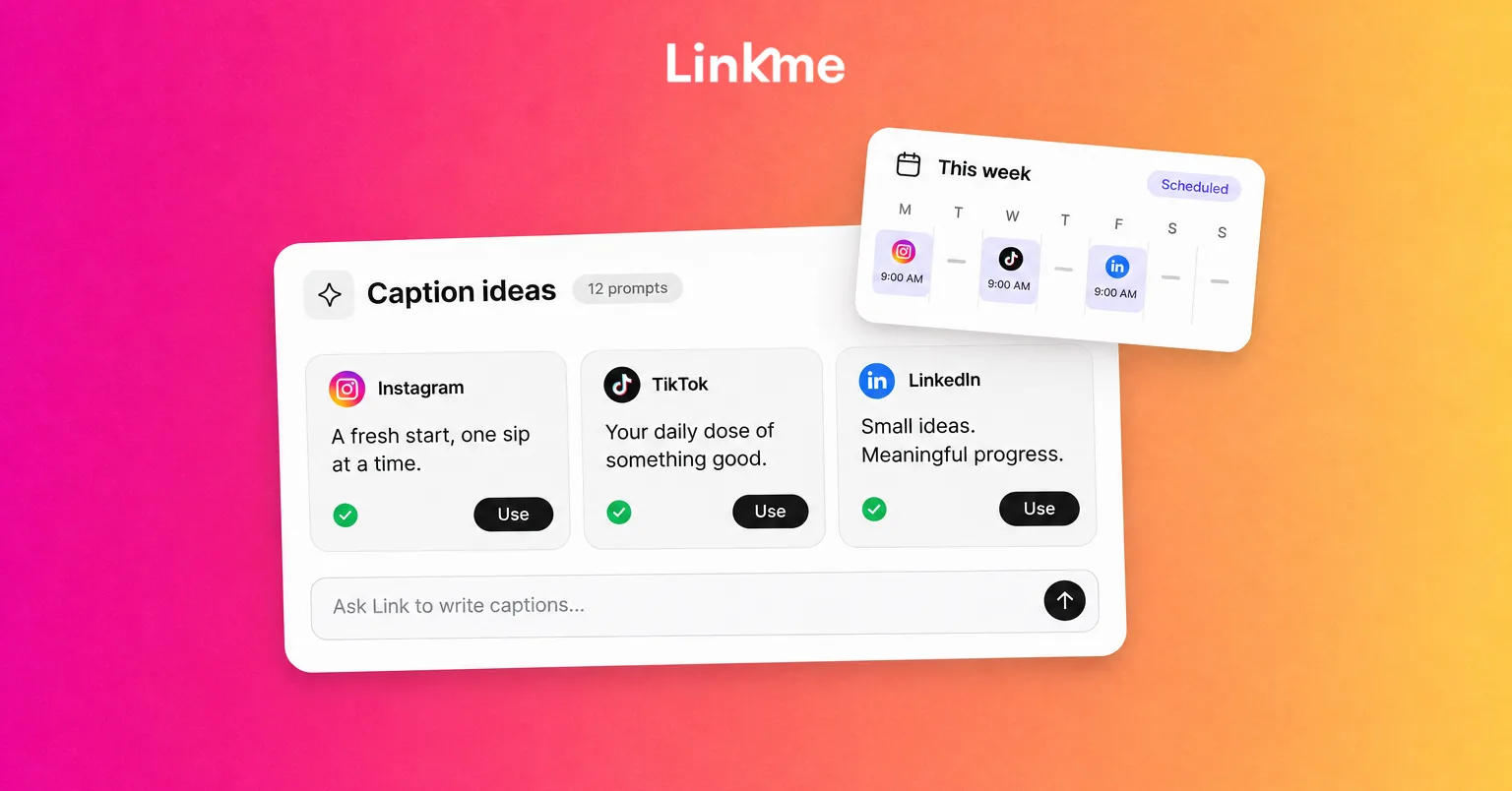
In Linkme, a clear brief gives Link the business information for a caption draft or basic content-planning request. Ask for a specific result, then revise the wording or supply missing context as needed.
Link is included in Linkme for Business, and its AI work uses credits. A request for caption alternatives or a table describes the answer you want; review the actual result before using it.
Once the copy and assets are ready, the team can prepare and schedule social posts. Link’s confirmation before a public action, your editorial fact-check and a team’s role-based sign-off are separate decisions. Where team review is required, follow the post approval workflow.
Keep planning and publishing separate: asking for a suggested week of content does not mean those posts are entered into a calendar or approved to go live. A draft-only instruction clarifies the request; the account’s permissions and actual confirmation steps still matter.
Check the result before you publish
- Match names, dates, prices, conditions and claims to approved information.
- Check that revisions preserve the source’s meaning and important qualifications.
- Compare the caption with the actual image or video, and test the intended action route.
- Resolve unfilled placeholders and unsupported additions; remove internal review notes.
- Complete the required editorial and product approval steps for the final version.
If a result is generic, supply the missing audience, message or constraint. If it invents a fact, identify the unsupported claim, restate the approved information and ask for a bounded revision. Review the new version too.
Frequently asked questions
What should I include in an AI caption prompt?
Include the message, audience, approved facts, channel, tone and requested output. Add the asset description and intended action where they affect the caption. The reusable brief above keeps those inputs together.
Can I use these prompts in different AI tools?
You can adapt the natural-language instructions to assistants that support the task. File access, memory, limits and connected actions differ. Supply the context the selected tool can actually read and check its response.
How do I keep AI captions in my brand voice?
Give concrete style preferences and, when useful, an approved example. Review the actual wording and ask for a specific revision. Keep the example’s style separate from its old facts or offers.
Does an AI content plan schedule my posts?
A suggested plan is a proposal. Scheduling depends on the product, connected accounts, permissions and confirmation steps. Check the actual publishing system before treating a post as scheduled.
Start with the brief and one task your business needs to complete. Keep the useful parts, correct the details and approve the content you can use.
See how Linkme connects content drafts, planning and reviewed publishing. Book a demo to explore the workflow for your business.