Social Media Lead Generation: How to Capture and Qualify Business Leads
Learn how to generate social media leads with useful offers, forms and conversations, then qualify inquiries, assign follow-up and track business outcomes.
On this page
- Decide what counts as a useful lead for your business
- Choose an offer and content that attract the right inquiries
- Choose how to capture the inquiry
- Qualify the inquiry and give follow-up an owner
- A worked example from social post to a useful business inquiry
- Measure lead quality and improve the weak step
- Frequently asked questions
- Connect capture to a useful next step
Social media can introduce a business to people who need its product or service. Turning that interest into a useful inquiry takes a clear next action, a workable way to respond and someone responsible for what happens afterward.
Social media lead generation is the process of attracting interest through social activity and turning it into an identifiable business inquiry or permission-based contact. A lead can begin in a direct message, a resource request or a form. It does not have to start with an email address, and it is not automatically a sale.
This guide covers how to attract relevant inquiries, choose a capture route, assess fit and follow up, with a practical business-to-business example.
Key takeaways
- Match the offer to the audience’s need and readiness.
- Give people a form or conversation route they can actually use.
- Collect the details needed for the next decision and explain the response.
- Assign qualification and follow-up to a person.
- Count inquiries, qualified leads and business outcomes separately.
Decide what counts as a useful lead for your business
Before changing your posts or building a form, define what the team is trying to generate. Otherwise, one person may report every signup as a lead while another counts only sales-ready inquiries.
Use working definitions that fit your business:
| Signal or stage | What it establishes | Next check |
|---|---|---|
| Like, follow or general comment | Attention or participation | Is there an expressed need or request? |
| Resource request, signup or inquiry | A defined request or contactable interest, where supplied | What did the person ask for, and what response is appropriate? |
| Qualified inquiry | Reviewed information meets the business’s stated fit criteria | Is there an agreed, useful next action? |
| Sales opportunity or customer | A separately recorded commercial stage or outcome | Confirm it in sales records rather than inferring it from a click |
Choose a few practical qualification criteria. Does the need match the product or service? Can the business supply it to this customer? Is the proposed next step appropriate? A local service provider might check geographic coverage; a product business might check the application or delivery requirements.
Keep unknown information separate from unsuitable fit. A missing detail can call for a question rather than rejection. There is no universal lead score or mandatory budget question that suits every offer.
An existing contact’s new inquiry can also be valuable without being a new unique lead. In B2B sales, several people at one company may be involved in one buying decision.
Choose an offer and content that attract the right inquiries
Match the next action to readiness
Someone researching a problem may want a practical checklist, guide, demonstration or educational event. Someone with an active need may want to ask about availability, request a quote or discuss a suitable product.
Make the next action fit that situation. Explain what a resource contains before requesting contact details, and consider whether it needs to be gated at all. For a service inquiry, state what the team will review and what response the person can expect.
Keep the promise specific. If a form starts a discussion, describe it that way. Avoid presenting it as an instant quote, confirmed booking or free assessment unless that is what the business actually provides.
A requested resource also needs a delivery process. Capturing an address does not, by itself, deliver the guide or fulfill the request.
Give potential buyers a reason to take that action
Use content to help the right person recognize a relevant need and assess the business. Four approaches can support that work:
- Answer a real buying question. Explain what customers should consider, compare or prepare, then offer a related next step. A useful answer should stand on its own before the call to action.
- Show credible evidence. Demonstrate the product, explain the service process or share an authorized customer example with accurate facts. Connect the evidence to the decision the reader faces.
- Make expertise accessible. Staff explanations, relevant community discussions and suitable partner contributions can help people understand an unfamiliar offer. Respond to the actual conversation rather than inserting the same sales message everywhere.
- Choose distribution deliberately. Use channels where relevant people engage and where the team can produce useful content. Review what generates suitable inquiries, not just what earns the most reactions.
LinkedIn can be useful for reaching business audiences, but it is not the only place B2B interest can begin. Likewise, a consumer-facing network is not automatically unsuitable for a business product. Audience relevance, content and the response route matter together.
Organic distribution and paid amplification play different roles. Paid placement can help test reaching an audience beyond current followers; the team still needs a relevant offer and a process for assessing responses. Referrals and partnerships can be useful when they fit the customer’s context, without assuming they will multiply leads by a set amount.
Choose how to capture the inquiry
Most businesses need to choose between a form and a conversation. Within forms, distinguish a page the business controls from a paid platform-native lead form.
| Route | When it can fit | What must happen after the response |
|---|---|---|
| Website or hosted page form | The offer needs context or a defined inquiry or request | Someone reviews the record, fulfills the promise and checks fit |
| Paid platform-native lead form | The team wants an on-platform response to an ad | Arrange retrieval, delivery and follow-up; verify relevant submitted details |
| Relevant direct message or conversation | A person asks a question or needs help deciding | Preserve the context, clarify the need and agree on a next step |
Organic posts and paid ads can both send people to a page form. A page form is not itself a paid advertising format.
For a native paid example, LinkedIn Lead Gen Forms attach to ads and can prefill profile and contact information. The associated advertising still has a cost, and prefilled details do not establish that the person is qualified. If the offer is a resource, arrange its delivery through a suitable confirmation link or your own fulfillment process.
Meta also offers form and messaging routes for lead generation. Choose the route that fits the intended response rather than assuming every platform has the same form, delivery or integration controls.
Before launch, test the actual path on mobile: the link, offer, fields, record destination and promised response or delivery. Identify test records so they do not get counted as campaign success.
Build a form that supports the next decision
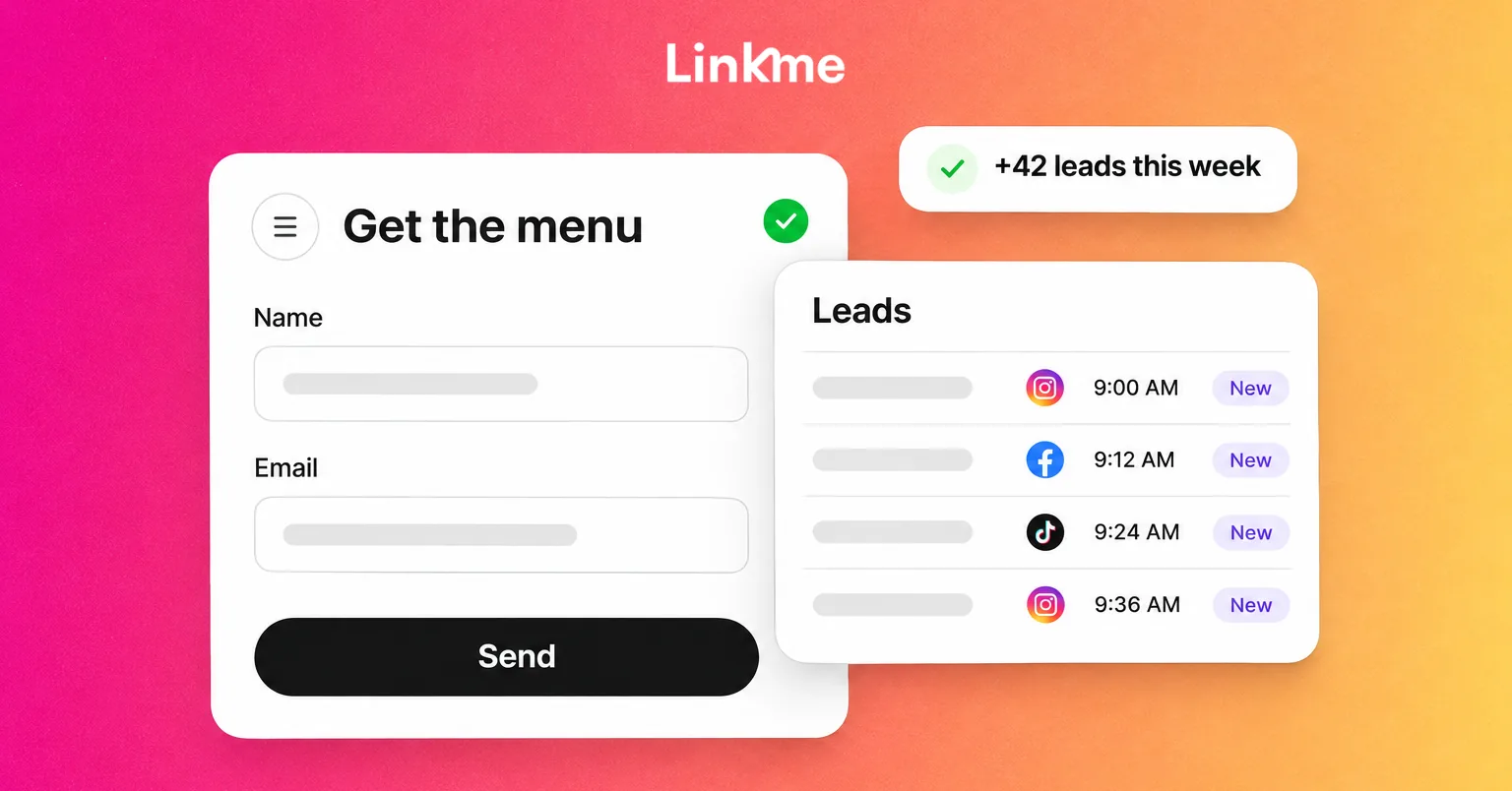
With Linkme Lead Capture, a team can build page forms using Text, Email and Mobile fields and choose which fields are required. Use those fields to collect the context needed for the requested response.
For an inquiry, that might mean a contact email, the need and a location relevant to service coverage. Ask for other details when they help the next decision. The shortest form is not automatically the most useful, and adding questions without a purpose creates unnecessary work for the prospect.
Check the storage setting. Submitters can be added to Leads, or answers can remain in Form Submissions only. Adding a record to a contact list is separate from judging fit, identifying a new unique person or understanding the person’s communication choices.
A named form also helps identify the collection mechanism. Its name does not independently establish which social post originally brought someone there.
Use conversations as a route, with a human next step
A conversation can clarify a need before asking someone to complete a form. Answer the relevant question and offer a suitable resource, inquiry route or agreed next step.
Linkme DM Automations can deliver a relevant link through supported comment or incoming-message triggers on Instagram business and creator accounts and Facebook Pages. Make the requested action clear: someone commenting a keyword should understand what they will receive.
Treat link delivery and inquiry capture as different events. A message sent, keyword activation or link click does not establish that contact details were collected or the person is qualified. Name a human owner for questions that need judgment and preserve the conversation’s context when handing it over.
Qualify the inquiry and give follow-up an owner
The useful handoff starts with what the person requested. A resource request calls for the resource; a service inquiry calls for a relevant response. Neither should disappear into a list with no next action.
Use a simple sequence:
- Read and fulfill the request. Check the original submission or conversation and deliver what was promised through the business’s chosen process.
- Review fit. Apply the criteria agreed for the offer. Verify important self-reported or prefilled details when needed.
- Resolve a useful gap. Ask an unanswered scope question or propose the appropriate next step.
- Assign ownership. Record who will act, the agreed channel and a due time the team can meet.
- Record the outcome. Distinguish a reply, confirmed fit, an agreed or held meeting, an opportunity and a closed commercial outcome.
Keep a compact working record:
| Record | Why it matters |
|---|---|
| Inquiry or contact reference | Connect the follow-up to the correct request |
| Requested action and relevant need | Preserve what the person actually asked for |
| Known source and capture time | Retain available context without inventing attribution |
| Communication preferences and request scope | Keep the response aligned with the person’s choices |
| Qualification status and reason | Separate confirmed fit, unsuitable fit and information still needed |
| Owner, next action and due time | Make responsibility visible |
| Eventual outcome | Show whether the inquiry progressed and what happened |
Keep these details in the team’s working record or customer relationship management system. Linkme contact CSV export can support a separate import into another tool; check the original form answers and the fields actually transferred.
Keep requested replies separate from optional ongoing marketing. Explain what someone will receive and respect their choices. Downloading one guide is not a request for every later promotion.
For appropriately subscribed contacts, you can use Linkme email campaigns for manual sends to selected or filtered recipients. Assign those sends deliberately; they are not scheduled sends or an automatic welcome series. A direct response to a service inquiry can use the team’s chosen communication process without requiring the person to become a marketing subscriber.
A worked example from social post to a useful business inquiry
Consider a fictional commercial cleaning business serving offices. It wants inquiries about recurring cleaning that its owner can review for service fit. Here is how its inquiry process could work.
Start with a useful post and a clear route
A Facebook Page post could explain what office managers should prepare before asking about cleaning:
Before requesting recurring office cleaning, note the areas that need attention, how often you need the work and any access requirements. Those details help define the scope.
Looking for a provider in [service area]? Use our Office cleaning inquiry form to tell us about your office and what you need. We’ll review the details and reply about whether we can help: [public Linkme page URL].
Replace the area and URL before publishing. The post’s clickable link leads to the business’s Linkme page, where the Office cleaning inquiry form is clearly labeled. The page explains that a team member reviews the request and responds; submission does not book a visit or produce an instant quote.
Collect the details needed for review
For this example, use the following form:
| Field | Type | Required? | Purpose |
|---|---|---|---|
| Contact email | Yes | A usable response route | |
| Office city or service area | Text | Yes | Check geographic fit without initially requiring a full street address |
| Cleaning need | Text | Yes | Understand the requested scope |
| Contact name | Text | Optional | Address the person appropriately |
| Company | Text | Optional | Business context to confirm as needed |
| Desired timing | Text | Optional | Plan the next question or response |
The fictional team enables Add submitters to my leads. Its business owner checks the original answers in Form Submissions and the corresponding contact record in Leads, then records fit and the next action in the team’s working record.
That setting does not mean every submission is a new person, a qualified inquiry or permission for unrelated marketing. The owner still needs to read the request and decide what response fits.
Ask the next useful question
If cleaning frequency was not supplied, a manual first response could be:
Hi [name], thanks for asking about recurring office cleaning in [area]. How often would your office need cleaning? If the location and scope fit our service, we can arrange a conversation about your requirements.
Use “Hi” without a name if none was supplied. If frequency was already answered, ask a different relevant unanswered question rather than sending the same script regardless of context.
The owner records the next action and due time. A scoping conversation is a possible next step after fit is checked, not an appointment already booked. Qualification, any eventual opportunity and the outcome are recorded when they actually occur.
Measure lead quality and improve the weak step
Separate raw submissions or messages from valid distinct inquiries, new unique contacts, qualified inquiries, meetings and commercial outcomes. Exclude tests and spam, and handle repeated requests deliberately. At a business account level, multiple contacts may belong to one opportunity.
Compare inquiries acquired during the same defined date range at a stated review date. Allow an appropriate observation period for follow-up and keep those awaiting review separate from unsuitable inquiries. Otherwise, older qualified leads can get mixed with unrelated recent submissions, or new inquiries can look unsuccessful before anyone has reviewed them.
Use the right source for each question. Form or conversation records show the request. The team’s qualification and sales records show reviewed fit and progression. Linkme-page visits and link activity describe activity on those pages; DM activations and clicks describe the message route. They are not an automatically joined lead-to-sale record.
Keep known campaign and source information with the inquiry, including gaps. A named form can identify the entry mechanism while leaving the originating post unknown. Shared profile routes and intermediate pages can limit post-level identification.
If paying for leads, compare spend and quality using the same scope, period and definition. A lower cost per submission can still accompany fewer suitable opportunities.
Use the results to choose the next check:
- Many responses, poor fit: Inspect audience selection, offer expectations and the questions used to assess need.
- Suitable inquiries, little progression: Inspect ownership, the relevance of follow-up and whether the proposed next step fits the request.
These are investigation prompts. The numbers alone do not establish the cause or guarantee that a particular change will solve it.
Frequently asked questions
What is a social media lead?
A lead is an identifiable request or contactable expression of interest that the business can respond to appropriately. It might begin in a form, resource request or conversation. A general interaction is not automatically a sales inquiry or customer.
Which social platform is best for B2B lead generation?
Choose based on the audience you need to reach, the content your team can provide and the capture route. LinkedIn can be useful for professional audiences, while other networks may also produce relevant business inquiries. Judge the fit and progression of the responses you receive.
Can you generate leads without paid ads?
Yes. Helpful organic content, relevant conversations, staff expertise and suitable referrals can lead to inquiries. A useful offer and follow-up process still matter, and organic activity does not guarantee a particular volume or timing.
Should you use a form or direct messages?
Use a form when structured details help review the request. A conversation can work when someone needs clarification before taking the next step. Either route needs clear expectations, preserved context and a follow-up owner.
Does downloading a resource make someone a qualified lead?
No. Fulfill the request, then assess relevant fit and intent separately. A download does not establish purchase readiness or a request for unrelated ongoing marketing.
Connect capture to a useful next step
Choose a relevant offer, provide a workable response route and make the handoff clear. Linkme’s forms, contact handling and supported message-to-link routes can support that capture process; the team supplies the judgment and follow-up that turn an inquiry into a business decision.
Explore Linkme for Business for capturing inquiries from your social traffic. Book a demo to discuss your team’s forms and follow-up workflow.