Franchise Social Media Marketing: How to Coordinate Content Across Locations
Build a franchise social media strategy that balances brand consistency and local relevance, with clear roles, approvals and reporting across locations.
On this page
- Key takeaways
- Choose how head office and locations will share the work
- Give head office and franchisees clear responsibilities
- Turn one brand campaign into useful local content
- Review, schedule and manage campaign changes
- Make customer replies part of the plan
- Measure what happens at each location, then improve the process
- Start with one campaign before expanding the process
- Frequently asked questions
Head office sends out a promotion. One location cannot offer it, another uses an old booking link, and a third is still waiting for approval when the campaign starts.
The creative may be consistent, but the customer experience is not.
Franchise social media marketing means coordinating brand and local social activity so customers recognize the business and get information that is useful where they live. The franchisor sets the brand direction; franchisees contribute the local knowledge that makes it relevant. A franchisee may operate several locations, with different people handling day-to-day content at each one.
A workable strategy connects those responsibilities. It gives head office visibility, gives location teams clear tasks, and takes a campaign from the first brief through publication, customer questions and results.
Choose how head office and locations will share the work
Decide which locations need their own social accounts
Start with the audience and the work involved. A location account makes sense when it can provide something customers need: local events, a distinct schedule, neighborhood partnerships, useful updates or answers about that location.
It also needs someone who can keep it active and respond. Before opening another profile, ask:
- Do customers need information that the brand account cannot provide clearly?
- Does the location have enough relevant material to sustain the account?
- Who will publish and answer questions when the usual contact is unavailable?
- Which networks do those customers use, and can the team create suitable content for them?
One brand account may be enough for a smaller network. Regional accounts can work where language or market differences matter. Location accounts can serve communities with distinct needs. Choose the coverage your team can support.
A local social account and a local destination page serve different purposes. Customers may need a page with a store’s hours and booking link even when that store does not run its own Instagram or TikTok account.
Pick a management model your franchisees can maintain
There are three useful starting points:
- Head-office-led: the central team prepares and publishes content. Locations supply facts and updates. This reduces local production work but puts more responsibility on head office to collect accurate information.
- Locally managed: franchisees handle their accounts within agreed brand standards. This gives them room to respond to local needs, but requires time, training and clear accountability.
- Shared: head office supplies campaign direction and assets; locations contribute details and content through an agreed review process.
The right choice depends on your people and operating arrangements. A shared model works only when the handoffs are clear.
Create a basic account inventory: location, network, current access holder, publishing owner and backup. Agree who handles recovery and access changes when staff leave. Follow the franchise’s existing arrangements rather than assuming every account has the same ownership structure.
Give head office and franchisees clear responsibilities
Set brand standards without removing local judgment
Tell locations what must stay consistent and where they can contribute.
Head office might provide the current logo, campaign artwork, approved offer wording and brand voice. Local teams can add accurate hours, event details, local availability, appropriate language and photos of their actual people or premises.
Put the latest assets and guidance in one accessible place, with a clear contact for exceptions. A location should know what to do when the campaign image is correct but the offer does not apply to its customers.
Written guidelines also need a working review process. A document describing approved edits does not, by itself, control what someone can publish.
Make local participation manageable
A franchisee may be managing staffing, stock and customers alongside marketing. Give them a defined contribution they can complete: confirm the offer, send a photo, check the destination and flag anything that is wrong.
Name a local contact and backup. Provide an example of a useful submission and a deadline. Give teams a simple route to suggest content or report a change, then use that feedback in the next campaign.
This sample division of work can help you agree responsibilities:
| Work | Head office / central team | Franchisee / local team |
|---|---|---|
| Campaign direction | Set the goal, core message, assets and campaign window | Confirm participation and local suitability |
| Local adaptation | Define required details and permitted changes | Supply accurate information, images and destination links |
| Review and publication | Assign the reviewer, backup and publishing permissions | Submit on time and answer corrections |
| Customer questions | Set the escalation route and handle brand-wide issues | Supply local answers and reply where responsible and authorized |
| Learning | Review patterns and share useful examples | Explain local context and suggest improvements |
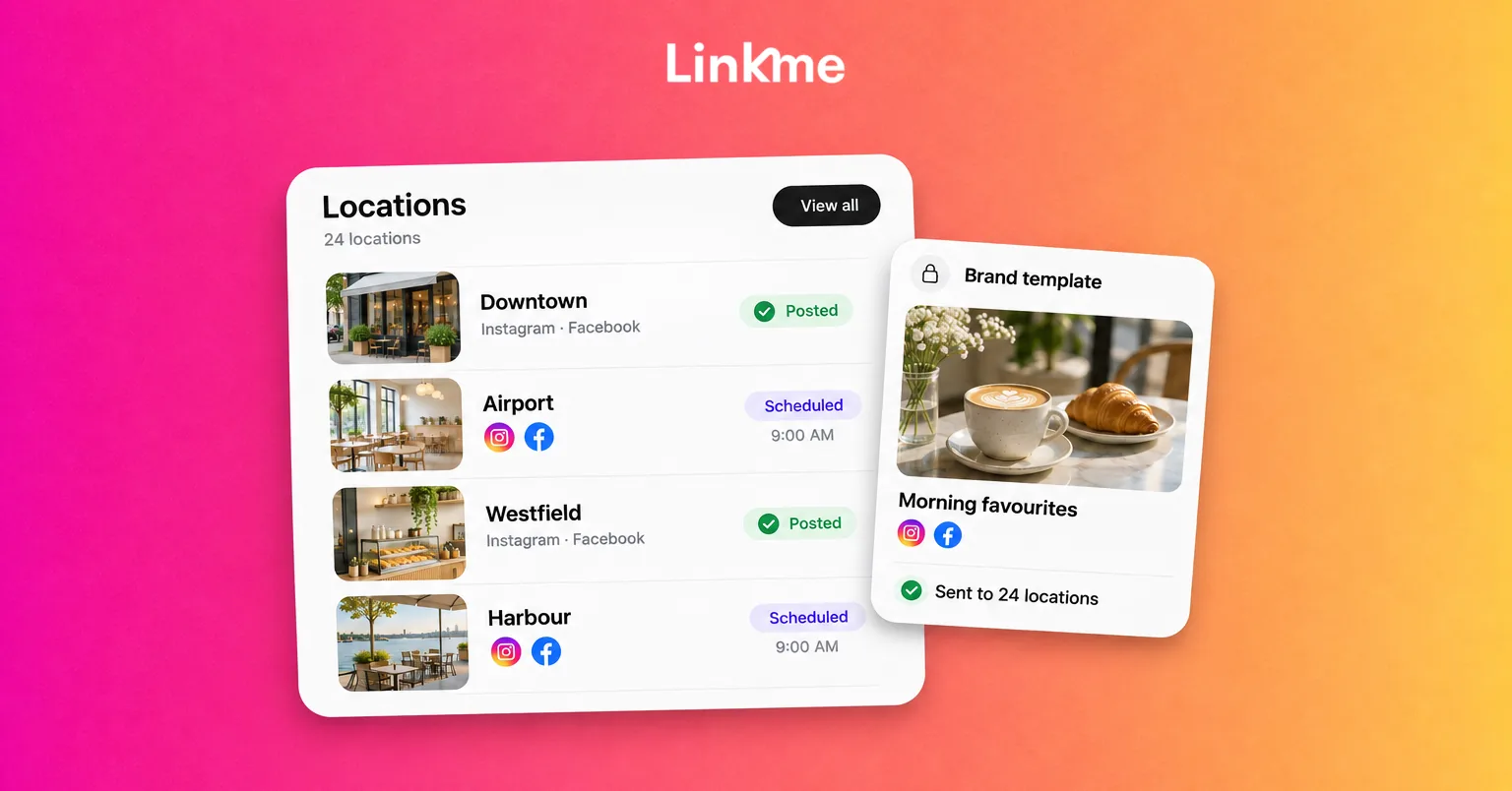
Account access should reflect that division. You can manage multiple locations in Linkme while limiting managers to their assigned location pages. That gives a regional manager a defined area of work while head office retains oversight.
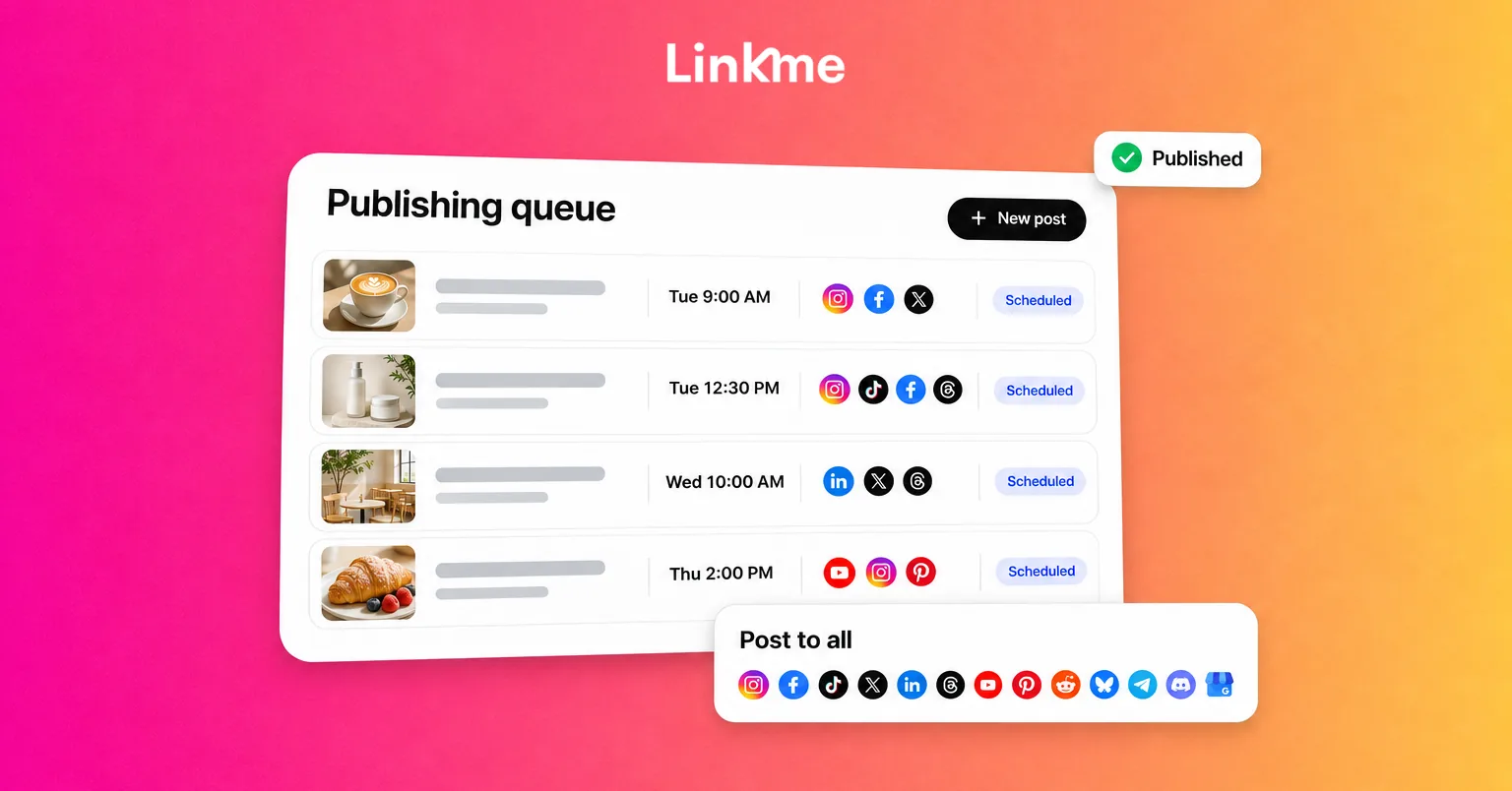
Linkme for Business gives teams shared drafts and a publishing calendar, with approval steps for posts that require review. Agree the access each person needs for their actual tasks, including who can publish and who handles customer messages.
Turn one brand campaign into useful local content
Combine shared campaigns with real local stories
Shared campaigns give the network a common message. Local content gives customers a reason to care about a particular location.
Alongside national promotions, leave room for staff introductions, community partnerships, local events and practical customer questions. A studio can introduce the coach leading its open house. A store can explain how its collection service works. Use photos you have permission to publish and details the local team has checked.
Changing a city name in an otherwise identical caption adds little. Local content should help someone decide whether to visit, book or ask a question.
There is no fixed split of central and local posts that suits every franchise. Plan around the material available and the work each team can maintain.
Keep shared campaigns and local posts in the same calendar, with the location, owner and publication time visible, so teams can spot gaps and conflicting promotions.
Give each location a campaign brief it can use
Every campaign brief should identify the goal, participating locations, approved message, assets, permitted edits, required local details, reviewer and deadline. Include the intended publication time and timezone, destination, campaign end date and contact for changes.
Consider a hypothetical fitness franchise running open houses. Downtown and Riverside participate; a third studio, Northside, sits this campaign out.
| Campaign element | Shared direction | Local adaptation |
|---|---|---|
| Purpose | Invite prospective customers to meet the team and see the studio | Confirm which studios can host visitors |
| Message | Use the approved event description and brand artwork | Add an actual studio photo and introduce the local coach |
| Details | Include date, time, venue and booking instructions | Downtown runs Saturday, May 8, 2027, 10 a.m.–noon; Riverside runs Sunday, May 9, 2027, 1–3 p.m., each in local time |
| Destination | Send people to the relevant booking information | Check each participating studio’s event link |
| Review | Check local facts before final approval | Resubmit changes to dates, availability or destination for review |
| Follow-up | Monitor questions and event status | Update affected posts and destinations if the event fills or changes |
The shared message could begin as an internal template:
Meet the team at our [studio] open house on [date], [time]. Explore the space and ask our coaches your questions. Reserve your place through [booking destination].
Downtown’s local version could read:
Curious about training at Downtown? Meet our coaches and explore the studio at our open house on Saturday, May 8, from 10 a.m. to noon local time. Reserve your place through the Downtown open-house link in our bio.
That version is ready only after the local team confirms the event details and the correct link is in the bio. Adapt the call to action to the network’s available link placement. Northside should not receive the same invitation when it is not hosting an event.
Send customers to the right location and next step
Check the destination as carefully as the caption. A post for Downtown should lead to Downtown’s event information, with the same date, time and booking instructions.
A national account promoting several locations may need a location selector. A local account can send people directly to its own booking page. Test the path on a phone: can someone find the right venue and complete the intended next step?
Location pages can bring the relevant information together when customers need several options. Pure Green’s brand and location pages illustrate that structure: a brand destination alongside separate pages for individual locations.
Use the shortest useful route. An event with one booking action may be best served by a direct link; a location with changing hours, offers and services may benefit from a page that organizes them.
Review, schedule and manage campaign changes
Make sign-off clear without creating a bottleneck
Give every post a reviewer, a backup and a review deadline. The team should know who to contact if a draft is waiting and publication is approaching.
Complete permitted local adaptations before submission. An approved image does not automatically approve a different offer, event date or destination.
In Linkme’s post approval workflow, managers who lack publish-without-approval permission for the relevant account submit posts for owner or admin review. Changes to an approved caption or scheduled time send it back for approval. Owners and admins can publish directly, so permissions matter alongside the written process.
In the open-house example, changing Riverside’s event time after sign-off needs another check. The caption, event page and booking details must agree before the revised post goes out.
Check each location, network and scheduled time
Before scheduling, check the participating profiles, media format, local details, link placement and intended publication time.
Pay attention to timezone settings. Linkme Business scheduling follows the business timezone, so confirm how the scheduled time translates to each location’s intended local time. Do not assume that the same clock time means the same thing across regions.
Assign someone to confirm that scheduled posts actually publish. If a post fails on one account, check that account’s status and the reported problem before retrying. The rest of the campaign being live does not mean every location’s post succeeded.
Decide who can pause, correct or withdraw a campaign
Plan for changes while you are planning publication. Who can pause a scheduled post if a studio closes unexpectedly? Who updates the booking destination if an event fills? Who decides what to do with a brand-sensitive issue?
Give the responsible people a route to act quickly and confirm the change is complete. Updating the caption alone will not fix an outdated booking page.
Recheck overdue posts before approving them. In Linkme, an overdue post can publish after approval. A late sign-off must not send out an invitation to an event that has already ended.
Make customer replies part of the plan
Publishing an invitation creates another job: answering the people who respond.
Assign routine location questions to someone who can get accurate local information. Route brand-wide issues to head office. Name a backup and agree coverage hours the team can maintain.
Suppose someone asks whether Riverside’s open house still has space. The response owner should check with that studio or its current booking record before answering. If head office manages the inbox, local staff can supply the facts through the agreed internal route without needing direct access to every conversation.
Keep private customer information out of public replies, and check whether a colleague has already responded. For a complaint or an issue outside the responder’s authority, pass it to the named contact with enough context to continue.
Review unanswered questions alongside publishing activity. A location that posts consistently but leaves interested customers waiting still has a gap in its campaign process.
Measure what happens at each location, then improve the process
Separate participation, engagement and business actions
Choose the campaign goal before publication. For the open house, that might be completed event bookings. The review should then distinguish whether posts went live, whether people engaged and whether tracked bookings followed.
| Question | Useful evidence | What it tells you |
|---|---|---|
| Did the campaign run locally? | Participating locations, published posts and unresolved failures | Where delivery or participation needs attention |
| Did people see or engage with the content? | Available native-network reach, engagement and relevant questions | Whether the content attracted attention and interaction |
| Did people reach the next step? | Location-page views, link clicks and click rate | Whether people explored the destination or opened its links |
| What tracked outcomes were recorded? | Campaign-linked bookings, inquiries or redemptions in the relevant system | Which customer actions can be associated with the campaign’s tracking |
You can compare activity across your Linkme pages using page views, link clicks and click rate. These are destination-page metrics. Use the relevant social network’s analytics for native reach and engagement, and the booking, CRM or sales system for completed outcomes.
Set up campaign identifiers, trackable links or redemption codes where the destination supports them. A link click is not a completed booking. A campaign-linked booking is useful evidence, but it does not prove that social was the customer’s only influence or capture every booking the campaign helped generate.
If outcomes cannot be linked to the campaign, treat total location bookings as context. Do not label them all social results.
Compare fairly and support the locations that need help
Compare equivalent periods and account for audience size, paid promotion, operating hours, local availability and campaign participation.
For the hypothetical open house, review Downtown and Riverside’s publication records, destination activity and campaign-linked bookings. Keep Northside in the participation register with its reason for sitting out; it does not belong in a comparison of outcomes among participating studios.
Look for the reason behind a difference. Did one post miss its window? Was a booking link wrong? Did a reviewer delay publication? Did the local team have fewer spaces available?
Those questions point to useful changes. Help a location fix its handoff, adjust the next brief or share a successful local idea across the network. Raw totals alone are a weak basis for judging the team.
Start with one campaign before expanding the process
Try the process with a manageable group of locations, including teams with different staffing and operating conditions.
- Choose a campaign goal and confirm which locations will participate.
- Agree the account model, access, local contact and backup.
- Share the assets and collect the facts only local teams can confirm.
- Check the reviewer, publishing permissions, timezone, destination and route for urgent changes.
- Publish, monitor replies and confirm each participating location’s posts went live.
- Review customer actions, local feedback and process failures before extending the approach.
This gives you a concrete workflow to assess when choosing software. Linkme for franchise teams connects location access, publishing and local pages so head office and location teams can work within their responsibilities.
Frequently asked questions
Should every franchise location have its own social media accounts?
Only where there is a clear local purpose and enough capacity to publish and respond. A brand or regional account may serve some locations well. Separate location pages for hours, offers or booking links can still be useful without opening every location on every network.
How much content should come from head office versus franchisees?
There is no universal ratio. Head office can supply campaign direction and reusable assets, while local teams add information customers need: availability, staff, events and community context. Adjust the mix to the material and capacity available.
What should a franchisee do if it cannot run a national promotion?
Flag the problem before scheduling and confirm that the location is excluded from the relevant posts. Agree an approved alternative where appropriate. If availability changes after publication, notify the campaign owner and update the affected posts and destination.
How can head office keep posts consistent without creating an approval bottleneck?
Provide clear briefs, define responsibilities and publishing permissions, and assign review deadlines and backups. Gather local adaptations before submission. Permitted changes in a brand policy still need to follow the publishing tool’s configured approval rules.
Good franchise social media coordination gives each team a clear job: head office sets direction, local teams contribute accurate information, and both learn from what happens next.
See how Linkme can support your franchise team’s publishing, approvals and location pages. Book a demo.